Roofing guide
TPO vs PVC vs spray foam for Dallas commercial roofs
Three systems cover most flat commercial roofs going on around Dallas today. Each can be the right answer, and each is the wrong one for some buildings. Here is how to tell which fits yours.
- We answer 24/7
- Dallas service office
Quick answer
TPO is the most common choice for Dallas flat roofs: a white, heat-welded membrane at a moderate cost. PVC is welded the same way and better suited to roofs exposed to grease or chemicals, such as restaurants. Spray foam is sprayed into one continuous insulating layer that can add slope to fix ponding, but it depends on a topcoat that must be maintained. The building's use, drainage and insulation decide.
By Cyril Cross, Roofing Guides Editor · Updated September 2026
The short version
- TPO: white single-ply membrane, heat-welded seams, reflective, moderate cost. The default for many warehouses, offices and retail roofs.
- PVC: also a white welded membrane, more resistant to grease, oils and many chemicals, usually costs more. Common over restaurants and some industrial uses.
- Spray foam: closed-cell foam sprayed in place, covered with a silicone or acrylic topcoat. Insulates, has no seams, and can be built up to correct ponding.
None of the three fixes a wet deck or saturated insulation underneath. Whatever goes on top, the survey and core samples come first.
TPO in more detail
TPO arrives in wide rolls and is mechanically fastened or fully adhered over insulation board, with seams welded by hot air into a single sheet. Its white surface reflects much of the sun, which matters on a Dallas roof in August. It handles foot traffic reasonably well and is easy to repair with welded patches. Its weak points are the details: poorly welded seams, flashing at curbs and walls, and punctures from dropped tools and HVAC service. Membrane thickness varies, and thicker sheets cost more and last longer. Our commercial replacement page explains tear-off versus recover.
PVC in more detail
PVC installs much like TPO and welds the same way, but its chemistry stands up better to animal fats, cooking oils and many industrial chemicals, which break down other membranes. That makes it the usual choice around restaurant exhaust fans, where grease collects on the roof. PVC also tends to stay flexible and weld well when it is repaired years later. The trade-off is cost, and on a plain warehouse with nothing harsh landing on the roof, TPO usually delivers similar service for less.
Talk to a Dallas roofer now
Describe the leak or the damage, and we will tell you whether it needs a tarp tonight or a scheduled visit this week.
(214) 429-4542Spray foam in more detail
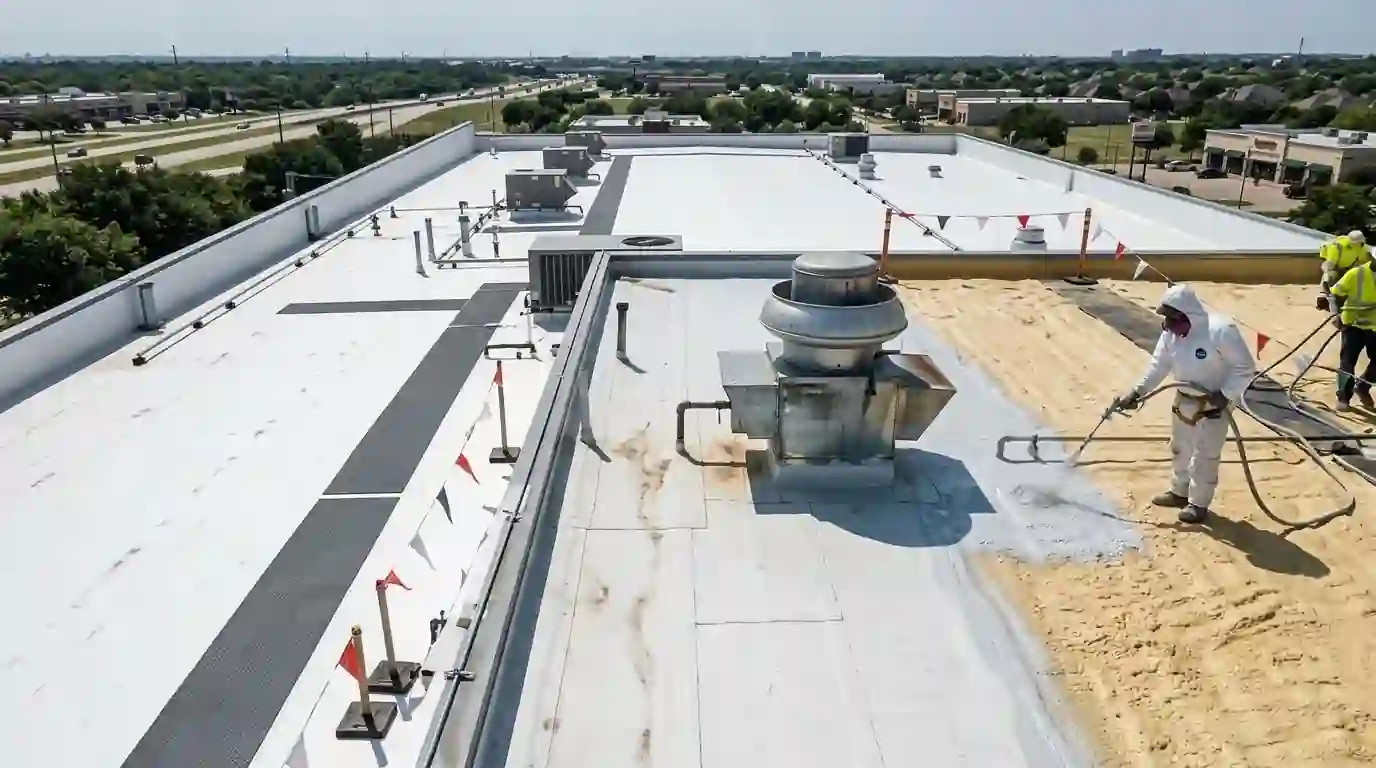
Spray foam is applied in place: the roof is cleaned and prepared, foam is sprayed in passes, and a topcoat goes on within a day. Because it is sprayed, it wraps around penetrations without separate flashings and can be built up in low spots, which makes it attractive on roofs that pond. It also adds insulation. It often goes over an existing roof that is dry, avoiding a tear-off. The catch is maintenance: foam must stay covered by its topcoat, which wears and needs recoating over the roof's life. See spray foam roofing for how it is installed.
Matching the system to the building
- Restaurant or kitchen exhaust on the roof: PVC, at least around the exhaust.
- Ponding you cannot fix with drains alone: spray foam, or tapered insulation under a membrane.
- Large warehouse with a tight budget: TPO, sized to the warranty term you need.
- Building that is hot and under-insulated: spray foam, or added insulation under TPO or PVC.
- Old metal roof: spray foam or a coating over the metal, or a retrofit system, depending on condition.
For a roof that is tired but dry, a coating may buy years without choosing any of the three yet.
Questions to ask every bidder
- What did the core samples show, and where were they taken?
- What membrane thickness or foam depth are you specifying?
- How will ponding be corrected?
- What warranty is offered, and what maintenance does it require?
- How are curbs, walls and drains flashed?
Bids that answer these in writing can be compared. Bids that only give a price per square foot cannot. Our commercial roofing page covers how we survey a building before recommending anything.
Keep reading
More guides on this
Questions we get
Commercial roof system questions
TPO usually costs least; PVC and foam depend on scope.
PVC resists the grease and oils that degrade other membranes.
It can, because foam is sprayed thicker in low areas.
White TPO and PVC, and foam with a white topcoat, all reflect most sunlight.
Sometimes, if the existing roof and insulation are dry.
Spray foam, because its topcoat must be renewed.
It depends more on installation, thickness and maintenance than on the system.
Choosing a system for your building?
We survey the roof, take cores and recommend the system that fits the building, in writing.