Commercial roofing
Commercial gutters and downspouts in Dallas
A commercial roof moves a lot of water in a Texas storm. When the gutters, scuppers or downspouts cannot keep up, it backs up onto the roof, over the storefront and into the building.
- We answer 24/7
- Dallas service office
- Box gutters to conductor heads
- 24/7Calls answered
- DallasService office
- EnnisHead office
- PhasedAround your tenants
Quick answer
Commercial gutter work in Dallas covers box gutters built into the roof edge, through-wall scuppers and conductor heads, oversized commercial downspouts, and storm repairs to all of them. Each system is sized to the roof area it drains, sealed to the roof membrane, and fastened for wind, so water leaves the roof quickly instead of ponding or spilling over the entrance.
Warning signs
Signs your commercial drainage is failing
Water over the storefront
Gutters overflowing at the entrance.
Stains on the wall below scuppers
Scupper or conductor head leaking.
Rust through box gutter liners
Water going into the wall.
Downspouts pulled off the wall
Straps failed in wind.
Ponding on the roof
Outlets undersized or blocked.
Water at the foundation
Downspouts discharging at the wall.
Dented conductor heads
Hail damage worth documenting.
The job
Why commercial drainage is its own job
Residential gutters hang on fascia. Commercial systems are often part of the roof itself: box gutters recessed behind a parapet, scuppers cut through the wall, conductor heads collecting the flow, and downspouts running down the face of the building to underground drains. When one piece fails, water backs up onto a flat roof or pours over a doorway.
We treat the whole path, from the roof surface to the ground, and seal each joint into the roofing so the drainage and the roof are one system.
Updated September 2026
Budget
What sets the price of commercial gutter work
Commercial drainage is priced by the run and the components; there is no published Dallas range we use. These factors set it.
- Linear feet
Gutter and downspout runs measured.
- System type
Box gutters, scuppers or hanging gutters.
- Metal
Gauge and material, galvanized to copper.
- Roof tie-in
Membrane lapped into gutters and scuppers.
- Height and access
Lifts for multi-story buildings.
- Underground tie-ins
Connections to existing storm drains.
- Storm repairs
Often part of an insurance claim.
Box gutters
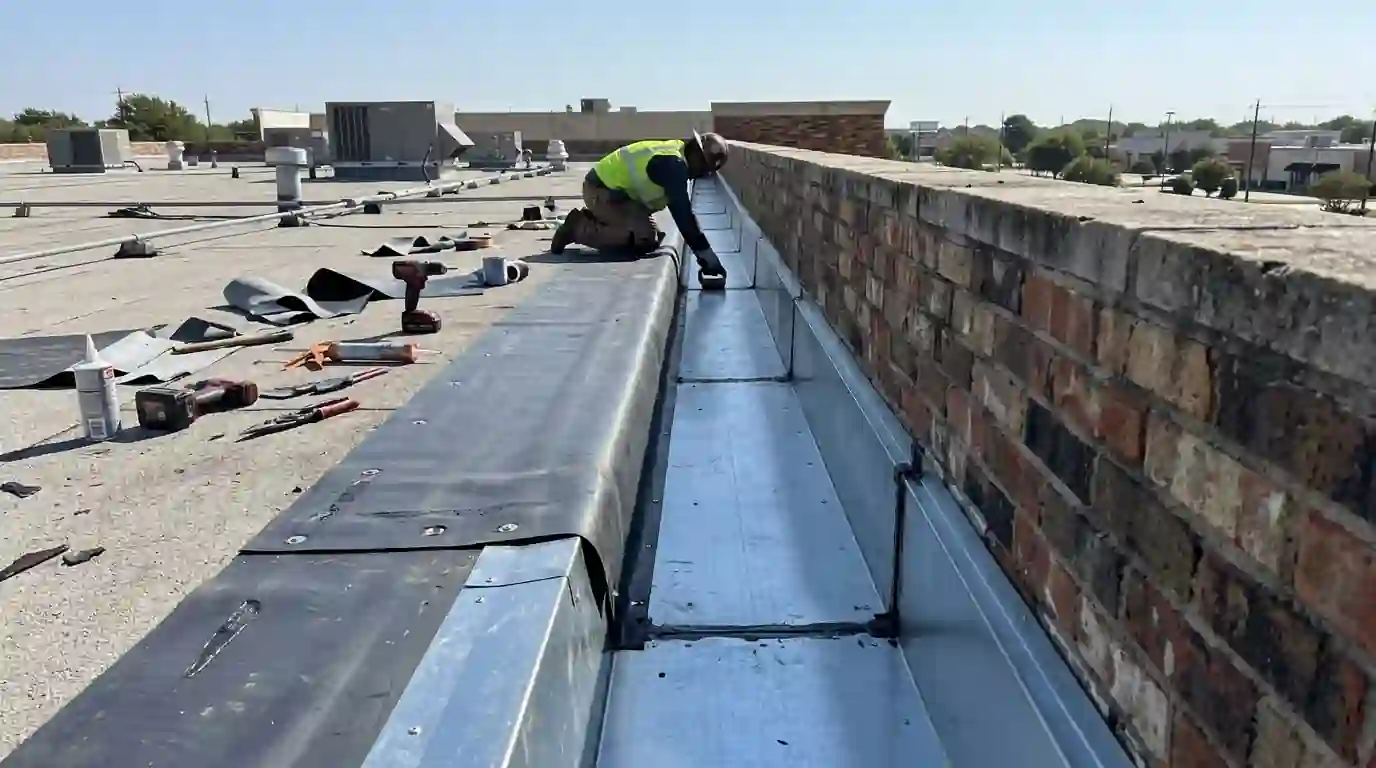
Box gutters sit inside the roof edge or behind a parapet, so a leak in one goes straight into the wall. They fail at soldered seams, where the lining has rusted through, and where the roof membrane was never properly lapped into them. We reline failed box gutters with new metal or a compatible membrane, rebuild the outlets, and make sure the membrane laps into the gutter so water runs over every seam, not into it. Soldered seams are water-tested before the job is closed.
Scuppers and conductor heads
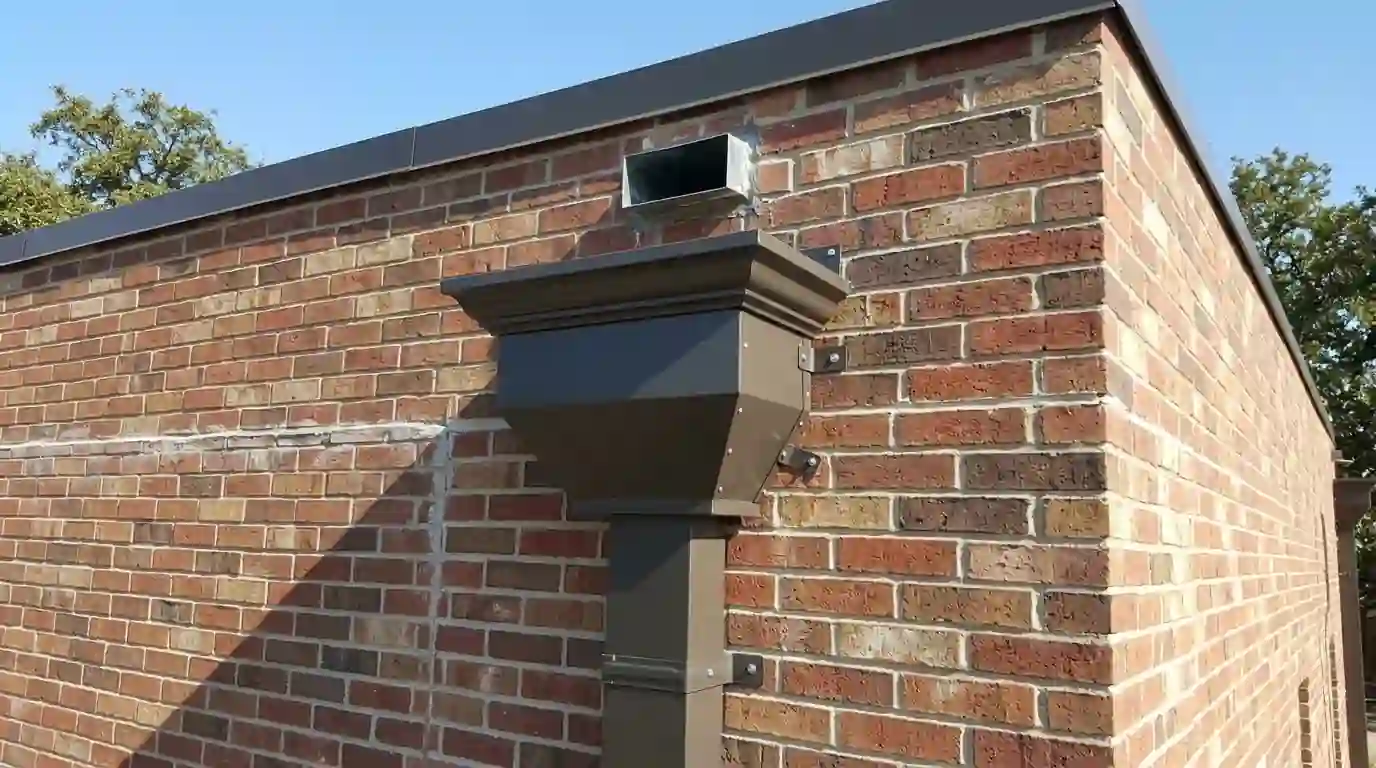
Through-wall scuppers drain a parapeted roof out through the wall into a conductor head and downspout. We replace rusted scupper liners, flash them into the roof membrane and the wall, and size the conductor head to the flow so it does not overflow at the top. Overflow scuppers, set higher than the primary drains, are checked on every job, because a roof with blocked drains and no overflow is carrying water weight it was never designed for. Every outlet is photographed for your building file.
Oversized downspouts
Commercial roofs need downspouts sized to the roof area they drain, often 4x5 or 6-inch round rather than residential 2x3. We install heavy-gauge downspouts strapped into the masonry or framing, with impact guards at the bottom where carts and vehicles hit them, and tie them into existing underground drains or discharge them away from walkways. Undersized downspouts are the most common reason a commercial gutter overflows in a heavy rain. Discharge points are chosen so water never crosses a walkway where it could freeze or cause a slip.
Storm damage to commercial gutters
Hail dents gutters and conductor heads, and wind rips gutters and downspouts off their straps, especially along exposed elevations. After a storm we photograph every damaged section for the claim, secure anything hanging, and replace runs that no longer drain. Gutters on older buildings often reveal rotten fascia or loose parapet coping behind them, which is repaired at the same time so the new gutter has something solid to hold. Anything hanging is secured the same day we are called.
Roofing in Dallas
What we see on Dallas roofs
When the March 8, 2025 storm tore the roof off a hotel along I-45 in Ennis and knocked out power across Ellis County, it also left gutters, downspouts and edge metal hanging off commercial buildings along the corridor. Wind like that finds any gutter strapped to rotten wood or any downspout held by a single clip. Our Ennis head office handles most of the commercial work in Ellis County, and we fasten every commercial run for wind as well as water.
Storm damaged the gutters on your building?
Call us to secure what is hanging and document the damage for your claim.
(214) 429-4542What happens after you call
How a commercial gutter job runs
Survey
Roof area, drains, scuppers and downspouts mapped.
Size the system
Gutters and downspouts sized to the flow.
Scope
Replacement, relining or repair in writing.
Schedule
Around tenants, traffic and entrances.
Install
Metal fabricated, fastened and sealed.
Tie into the roof
Membrane lapped into every outlet.
Water test
Flow checked from roof to ground.
Questions we get
Commercial gutter questions
A gutter built into the roof edge or behind a parapet.
Undersized or blocked gutters and downspouts.
The box that collects water from a scupper into a downspout.
Yes, to existing storm drain connections.
Yes, including early or weekend scheduling.
Yes, and we photograph damage for the claim.
Yes, where the roof needs a secondary path.
Yes, which is the best time.
Water pouring over the entrance in every storm?
We size and seal the whole drainage path so the roof sheds water as fast as Texas rain arrives.