Storm and emergency
Roof leak repair in Dallas
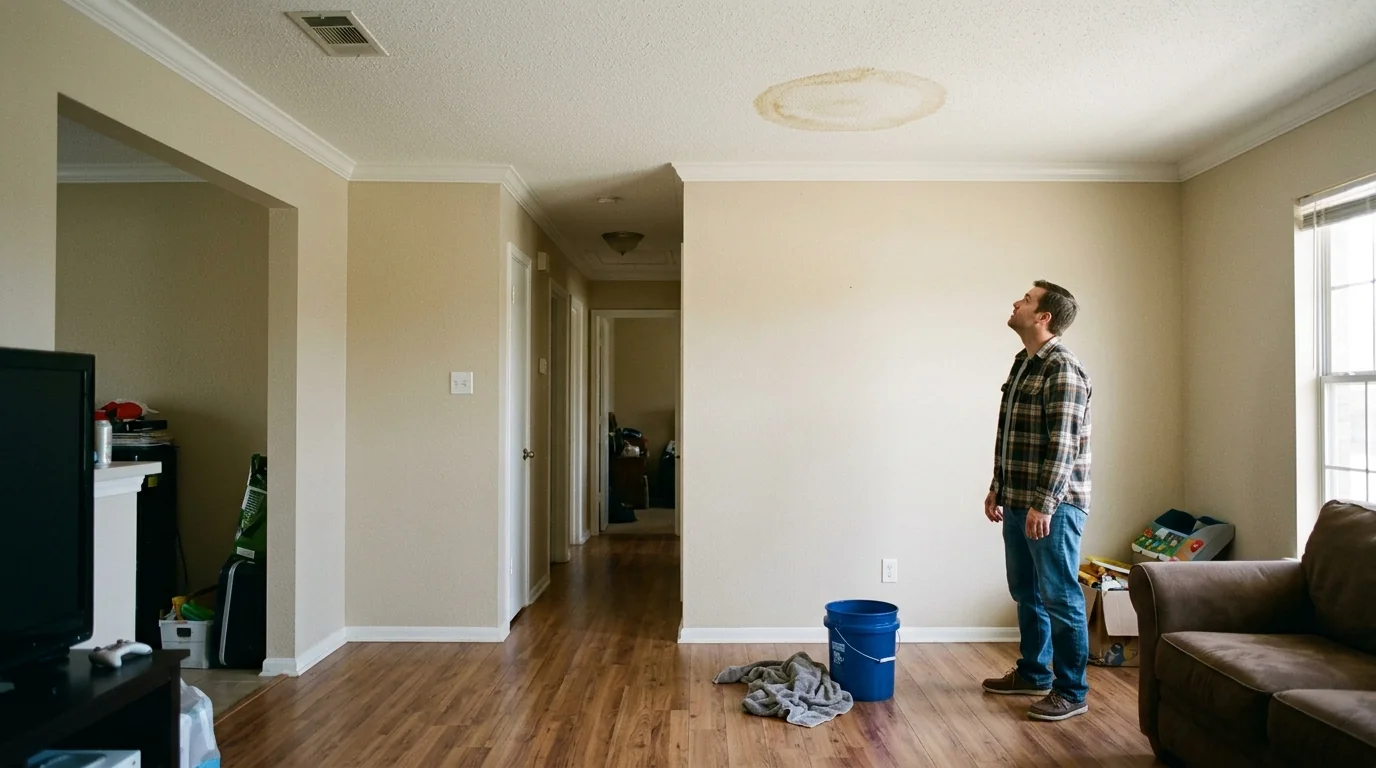
The stain is rarely under the hole. Water enters at a pipe boot, a valley or a flashing, runs down the deck and along a rafter, and shows up somewhere else. Fixing it means finding where it starts.
- We answer 24/7
- Dallas service office
- Traced from the attic up
- 24/7Calls answered
- DallasService office
- EnnisHead office
- 1 to 2Days, most re-roofs
Quick answer
Roof leak repair in Dallas starts in the attic: we follow the water trail on the underside of the deck back uphill to where it enters, then fix that spot from the roof, usually a split pipe boot, a failed valley, loose step flashing or a nail pop. Minor roof repairs in Dallas need no permit, so most leaks are fixed on the first or second visit.
The job
Why leaks show up in the wrong place
Water that gets under a shingle runs down the underlayment until it finds a nail, a seam or a gap, then along the deck and rafters until it drips onto the ceiling. The stain can be several feet downhill of the entry point, sometimes in another room.
So we start inside, in the attic, with a flashlight on the underside of the deck. Staining, wet insulation and daylight through nail holes point uphill to the real source.
Updated September 2026
Warning signs
Signs of a roof leak before the ceiling stains
Wet insulation in the attic
Dark, matted spots under the deck.
Rusty nails through the deck
Condensation or water around them.
Musty attic smell
Moisture trapped for weeks.
Peeling paint near the ceiling
Water behind the drywall.
Split pipe boots
Visible from a ladder.
Shingle granules in the valley
Worn valley shingles.
Drips around a light fixture
Vent or boot above it.
What happens after you call
How a leak repair runs
Call
Where it drips, when it drips and in what kind of rain.
Attic trace
Water trail followed uphill on the underside of the deck.
Roof check
Entry point confirmed from above.
Photos and scope
What failed and what the fix is, in writing.
Repair
Boot, valley, flashing or shingles replaced correctly.
Water test
Hose test on the repaired area where practical.
Follow-up
Check after the next rain if the stain was large.
Ceiling stain leaks
A brown ring on the ceiling tells you water reached the drywall, not where it came in. We map the stain against the roof above, trace the wet path in the attic, and check whether the leak is active or old. A stain that grows only in wind-driven rain points to flashing; one that shows in any rain points to a boot or an opening in the field. Once the roof is fixed, the drywall needs to dry fully before it is primed with a stain blocker.
Valley and dead-valley leaks
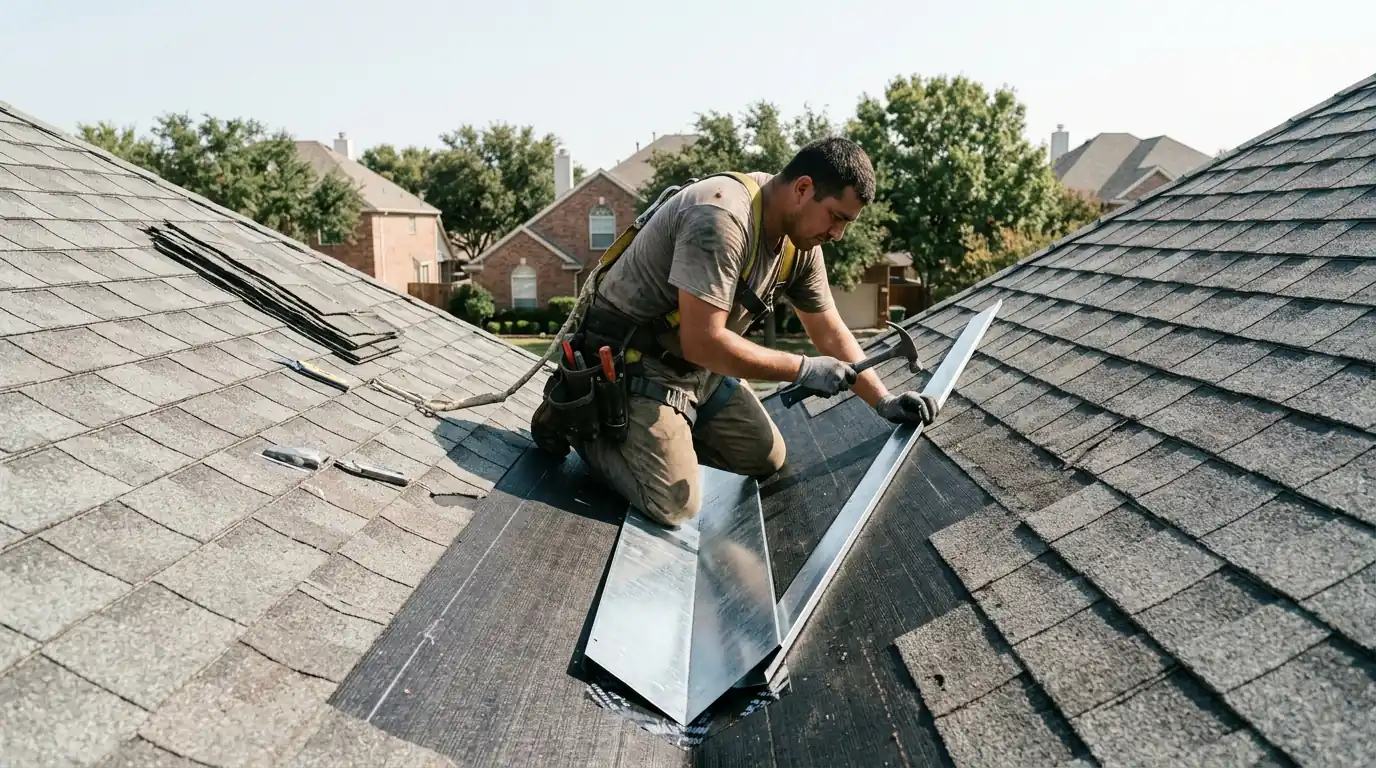
Valleys carry the most water on the roof and fail first. Open metal valleys rust or lose their sealant; woven and closed-cut valleys crack where the shingles bend. Dead valleys, where a roof plane runs into a wall or another slope with nowhere for water to go, need a cricket or extra membrane. We cut out the failed valley, install ice and water shield underneath, and rebuild it with new metal or shingles. Valley repairs are photographed step by step.
Pipe boot leaks
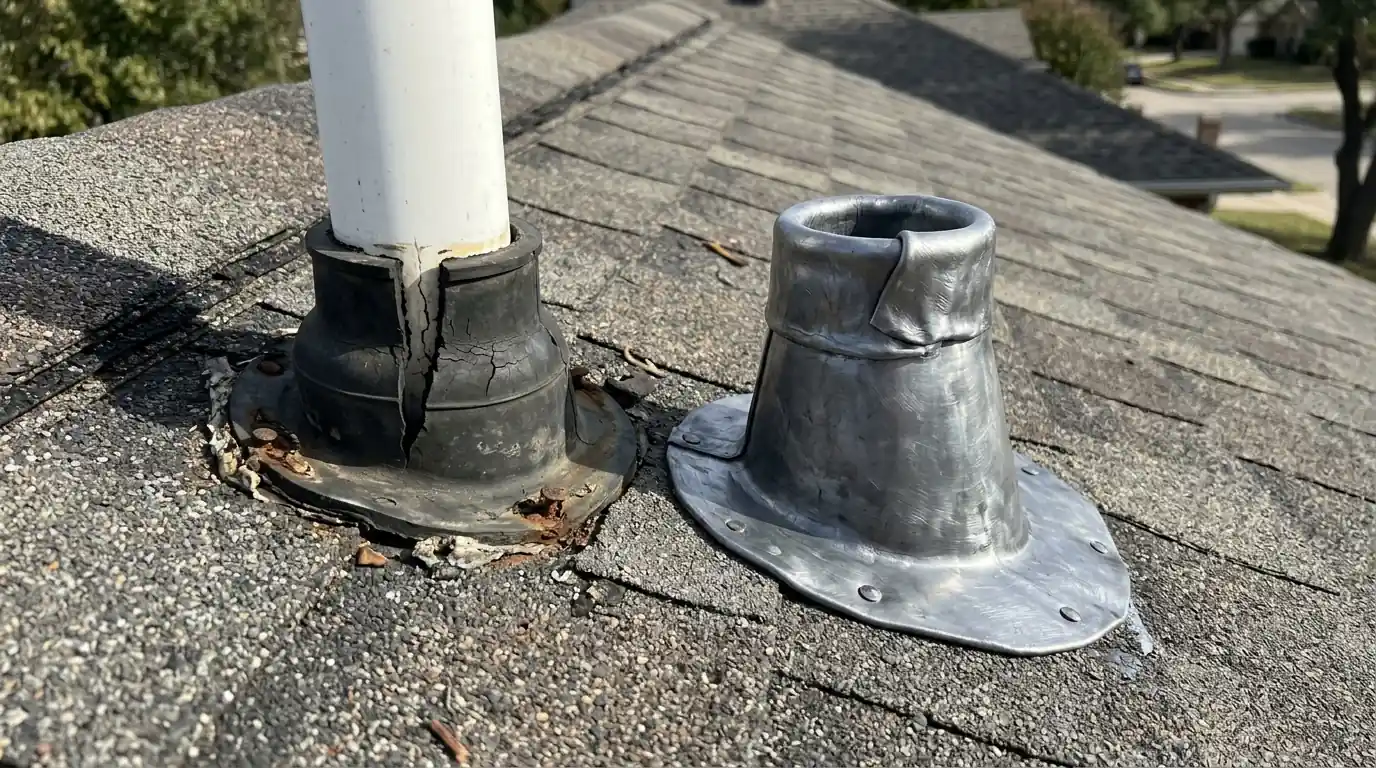
The rubber collar on a plumbing vent boot splits after years of Dallas sun, and the water runs straight down the pipe into a wall or the ceiling below. It is the single most common leak we find. The fix is a new boot, or a lead or silicone boot that outlasts the shingles, woven in under the course above and nailed with sealed heads. It takes under an hour, which is why we check every boot on every visit.
Skylight and vent leaks
Skylights, box vents, turbines and exhaust hoods all rely on flashing around their base. A skylight leak usually shows as stains at the shaft corners; a vent leak shows as a ring around the ceiling fixture below it. We replace the flashing kit or the vent itself, weave it under the shingles correctly, and never rely on caulk alone, because caulk around a skylight is the reason it leaks again the next spring. Old vents that were caulked shut get replaced outright.
Do it yourself or call
Tracking a leak yourself or calling us
You can help narrow it down. The repair is where most DIY goes wrong.
| Task | Doing it yourself | Having us do it |
|---|---|---|
| Checking the attic in rain | Safe and useful; note where water appears. | We trace it back to the entry. |
| Caulking the roof | Temporary at best; hides the source. | Failed part replaced. |
| Replacing a pipe boot | Possible on a low roof with care. | Woven in and sealed in under an hour. |
| Rebuilding a valley | Needs ice and water shield and correct laps. | Rebuilt with new metal or shingles. |
| Patching drywall | Wait until it is fully dry. | Roof fixed first, so the patch lasts. |
Roofing in Dallas
What we see on Dallas roofs
Dallas does not require a permit for minor roof repairs or roof vents, so a leak repair here is scheduled around the weather rather than the permit office; the permit only comes in when a repair grows into replacing large areas of the roof or structural members. That is also why we tell you on the first visit whether the leak is a repair or the first sign of a roof that needs replacing, because the second one follows a different timeline and paperwork.
Budget
What decides the cost of a leak repair
Leak repairs are priced by what fails; there is no published Dallas range that fits them. These factors set it.
- Entry point
A boot is small; a rebuilt valley or chimney flashing is larger.
- Decking damage
Soft sheets under the leak replaced per sheet.
- Roof material
Tile and metal take longer to open and close.
- Access
Steep or two-story roofs slow the work.
- Number of sources
Some roofs have two leaks close together.
- Interior
Wet insulation removed; drywall is separate.
- Roof age
Brittle shingles limit how much can be repaired.
Questions we get
Roof leak questions from Dallas homeowners
Wind-driven rain gets past worn flashing that light rain runs off.
Usually, by tracing stains in the attic and checking the roof above.
Not by itself. Most leaks are one failed part.
Not for minor repairs in Dallas.
We fix the roof; drywall is patched once it dries fully.
Most are done in a few hours.
Caulk hides the leak for a season and traps water.
Storm-caused leaks often are; wear-and-tear usually is not.
Stain on the ceiling? Find the real source first
We trace it from the attic up and fix the entry point, so the stain does not come back after the next storm.