Commercial roofing
Commercial roof repair in Dallas
A commercial leak is a business problem before it is a roofing one: a wet ceiling tile over a register, a tenant on the phone, inventory under a drip. We find the entry point and close it.
- We answer 24/7
- Dallas service office
- Low-slope and metal systems
- 24/7Calls answered
- DallasService office
- EnnisHead office
- PhasedAround your tenants
Quick answer
Commercial roof repair in Dallas starts on the roof, not under the drip: water on a low-slope roof travels along the deck before it shows, so we trace it back to the open seam, split flashing, clogged drain or failed penetration. We weld or tape TPO and PVC seams, patch EPDM and modified bitumen, clear and rebuild drains, and reflash rooftop units, often the same day.
The job
Why flat roof leaks show up far from the hole
On a low-slope roof water runs sideways under the membrane and along the flutes of a metal deck until it finds a joint to drop through. The stain inside can be twenty feet from the actual opening, which is why we walk the roof with a moisture meter and probe before cutting anything.
Most commercial leaks come from the same short list: seams, flashings at walls and curbs, drains, and the penetrations other trades added after the roof went on.
Updated September 2026
Warning signs
Signs a commercial roof needs repair now
Stained ceiling tiles
Usually well away from the actual opening.
Water standing two days after rain
Ponding that ages the membrane.
Lifted seam edges
Visible wrinkles or open laps.
Blistered modified bitumen
Trapped moisture under the cap sheet.
Loose edge metal or coping
Wind lifting the perimeter.
Cracked pitch pans
Sealant pulled away from pipes.
Musty smell in the building
Wet insulation above the ceiling.
What happens after you call
How a commercial repair call runs
Call and triage
What is leaking, where, and whether operations are affected.
Roof walk
Moisture readings, seam probing, drains and penetrations checked.
Temporary seal
Active leaks sealed the first visit where weather allows.
Photo report
Findings marked on a roof plan with photos.
Permanent repair
Seams welded, flashings rebuilt, wet insulation replaced.
Water test
Repaired areas flood or hose tested.
Maintenance note
What else on the roof is close to failing, in writing.
Timeline
How long a commercial repair takes
Most seam, drain and flashing repairs are finished in one visit. Wet insulation replacement adds a day for every few hundred square feet, because boards are cut out and replaced in sections that are closed before the crew leaves. Ponding corrections with tapered crickets are scheduled like a small project, typically two to three days.
Membrane seam leaks
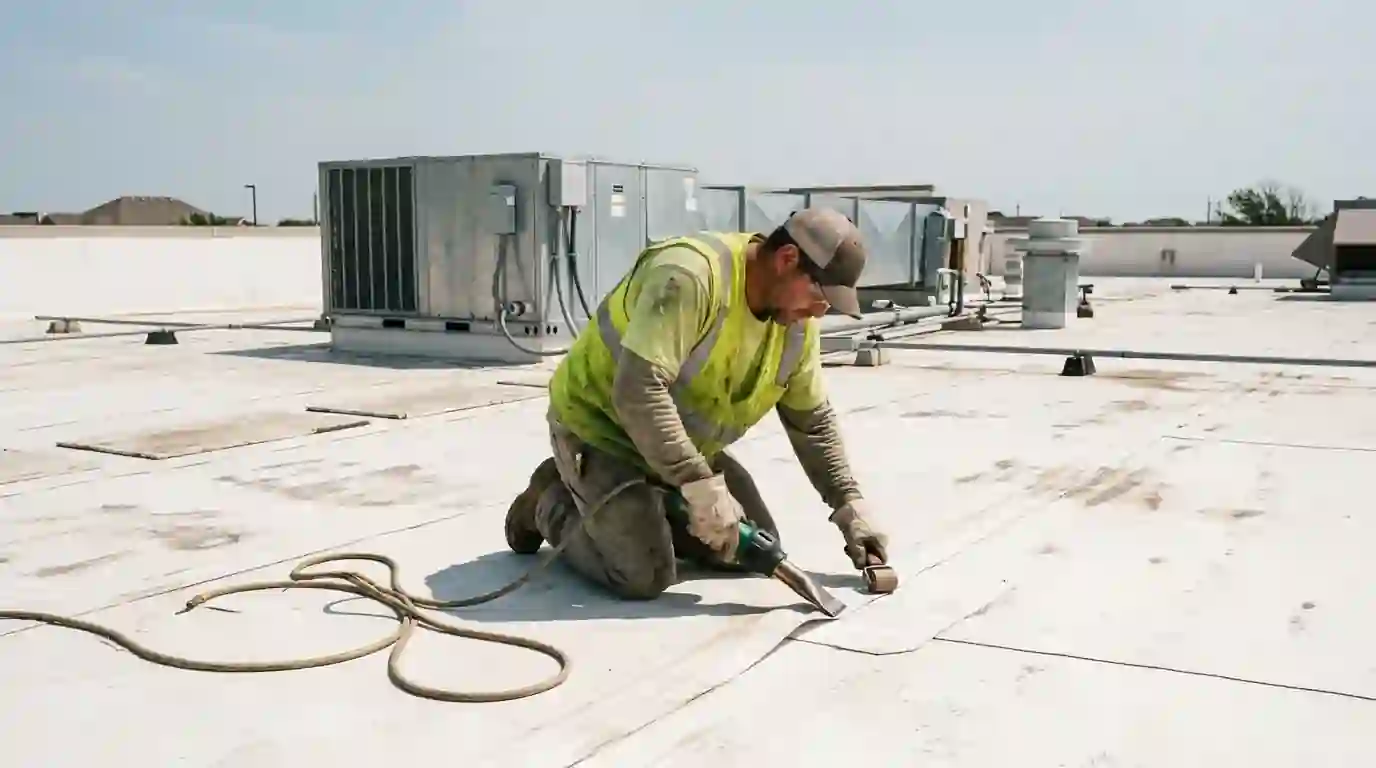
TPO and PVC seams are heat welded; a seam that was under-welded at install or opened by thermal movement will lift at the edge. We clean the membrane, probe the full seam run, and re-weld with a hot-air welder, adding a cover strip where the old weld cannot be trusted. EPDM seams use tape and primer instead, and modified bitumen laps are torched or cold-applied. Every repaired seam is probed again once cool, because a weld that looks closed can still be open underneath.
Ponding water
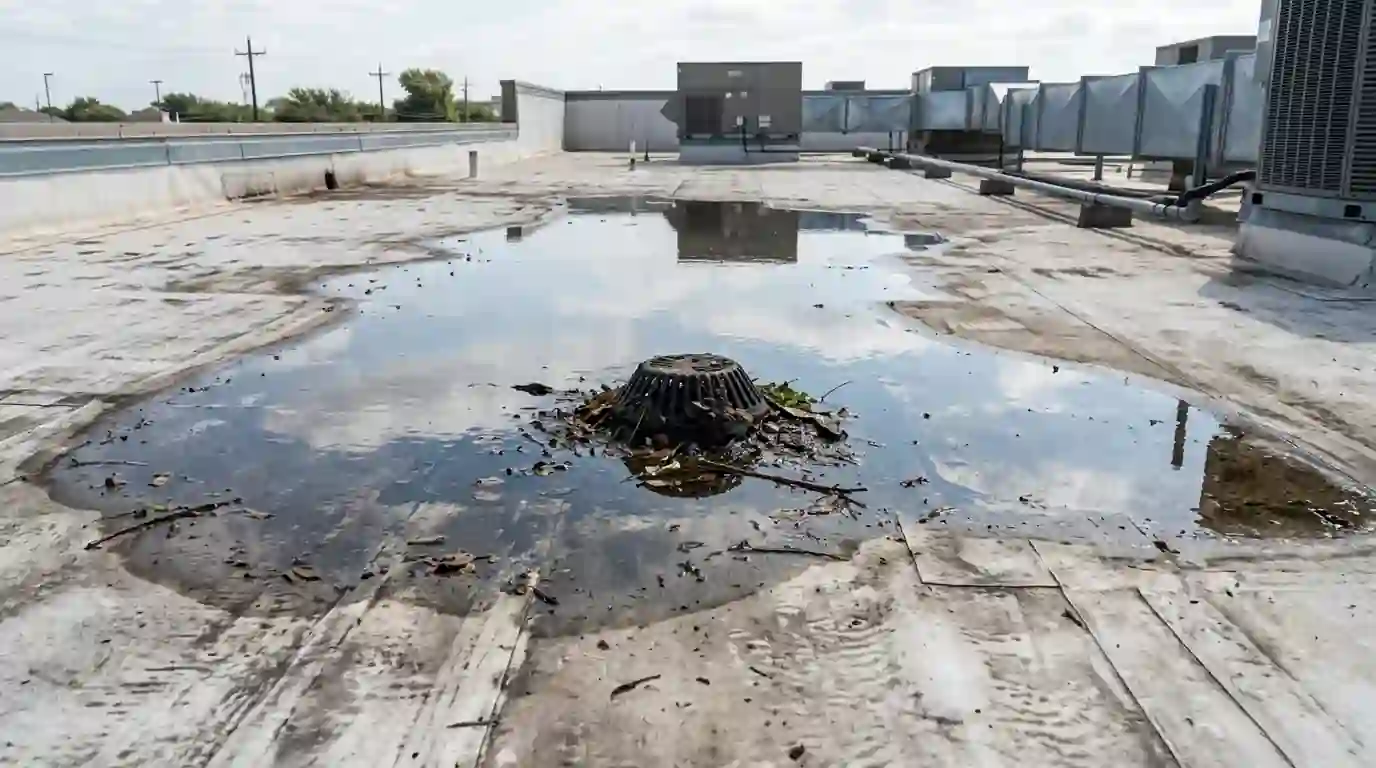
Water that stands more than 48 hours after rain ages the membrane, adds weight to the deck and finds every weak seam in the puddle. The cause is usually a low spot from deck deflection, a clogged drain, or insulation that crushed under foot traffic. We clear the drains, mark the ponding footprint, and correct it with tapered insulation crickets or an added drain, rather than just patching the membrane in the middle of the pond and waiting for the next storm.
Drain and scupper repair
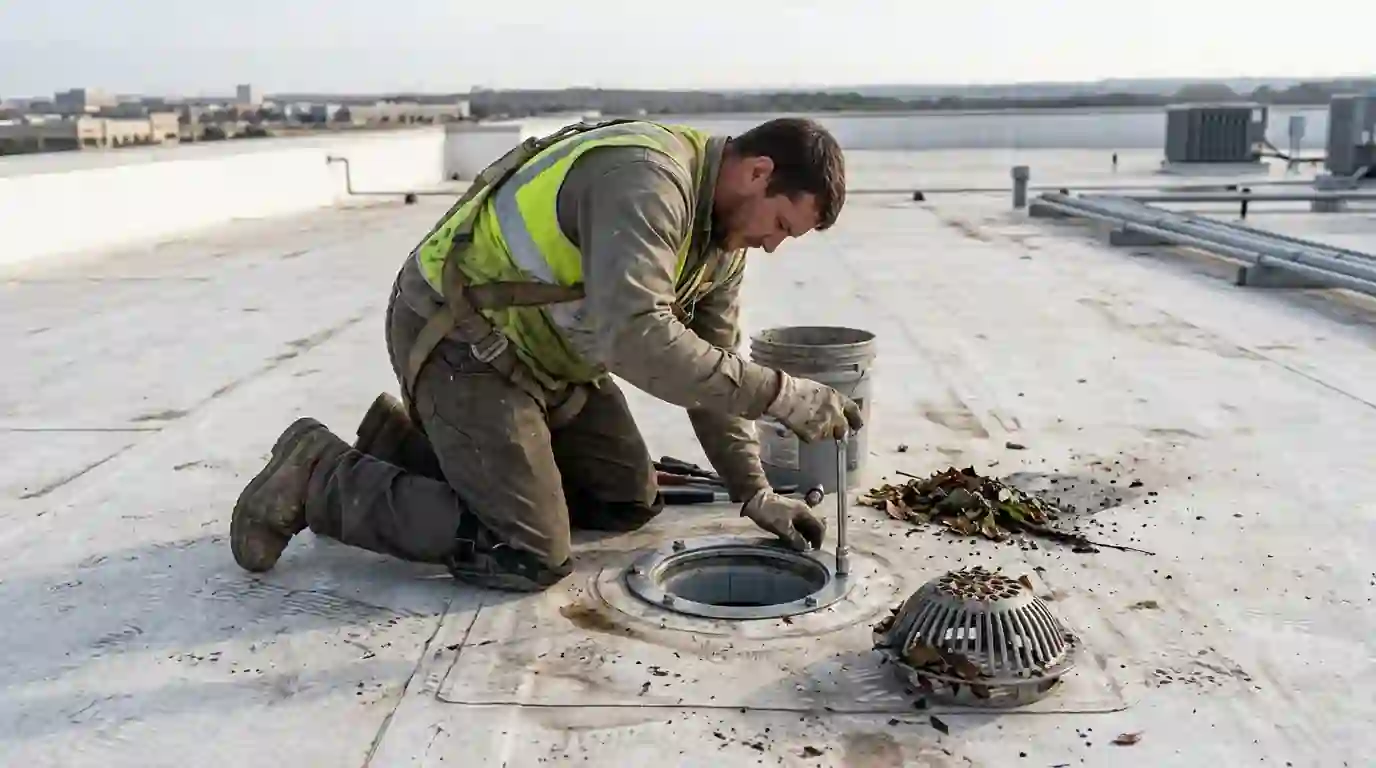
Interior drains clog with leaves, gravel and debris, and the clamping ring that holds the membrane to the drain body loosens over time. We clear the line, replace missing strainers, reset the clamping ring with new sealant, and replace cracked drain bowls. Scuppers through parapet walls get new liners and membrane flashing, like our commercial scupper and downspout work. On older buildings we also check that the overflow scuppers are open, because a blocked primary drain with no overflow is how roofs collapse under water weight.
Rooftop unit and penetration leaks
HVAC curbs, exhaust fans, conduit and gas lines are the penetrations added after the roof, often by other trades, and each one is a possible leak. We reflash curbs with membrane or metal counterflashing, replace cracked pitch pans with pre-molded boots where the pipe allows, and seal conduit supports that were set straight on the membrane. When a unit is being replaced, we coordinate with the mechanical contractor so the curb flashing is done once, correctly. Every reflashed penetration is photographed for your building file.
Roofing in Dallas
What we see on Dallas roofs
Ellis County saw what a North Texas squall line can do to a flat commercial roof on March 8, 2025, when the storm tore the roof off a hotel along I-45 in Ennis and knocked out power to about 6,000 residents across the county. Commercial buildings on that corridor take wind at the parapets and edge metal first, so after a storm our Ennis head office checks perimeter securement and coping before anything else on the field of the roof.
Budget
What sets the cost of a commercial repair
Commercial repairs are priced to the scope on the roof; there is no published Dallas range that fits them. These factors move the number.
- Membrane type
TPO, PVC, EPDM, mod bit or metal each repair differently.
- Seam footage
Re-welded or taped seams are priced per foot.
- Wet insulation
Saturated boards are cut out and replaced.
- Drains
Clearing is minor; a new drain body is not.
- Penetrations
Each curb or pitch pan reflashed adds a line.
- Access and height
Roof hatches, ladders or a lift for material.
- After-hours work
Occupied buildings may need night or weekend work.
Questions we get
Questions building owners and managers ask
Yes. We answer 24/7 and schedule around tenants and operations.
Water travels under the membrane and along the deck before it drops.
Yes, plus PVC, built-up and metal roofs.
The report says which. A roof with many wet boards is usually a replacement.
Yes, and we coordinate with your mechanical contractor for curb work.
We document damage for the claim and meet the adjuster on the roof.
Deck deflection, clogged drains or crushed insulation; each has its own fix.
Yes, a semi-annual inspection program.
Water coming through the ceiling tiles? Get a roofer up there
We trace the leak to its entry point, seal it, and hand you a photo report of what else on the roof needs watching.