Commercial roofing
Built-up and gravel roof repair in Dallas
Plenty of older Dallas commercial buildings still carry a built-up roof under a layer of gravel. It can last a long time, but when it leaks, it takes someone who knows how the plies were laid to fix it.
- We answer 24/7
- Dallas service office
- Commercial low-slope work
- 24/7Calls answered
- DallasService office
- EnnisHead office
- PhasedAround your tenants
Quick answer
Built-up roof repair in Dallas covers the multi-ply asphalt and felt roofs, usually surfaced with gravel, found on older commercial buildings: cutting out and re-plying blisters and splits, rebuilding gravel stops and edge metal, renewing the flood coat and gravel where it has worn thin, and recovering a tired BUR with a new single-ply or modified system when repairs no longer make sense.
Warning signs
Signs a built-up roof needs repair
Bare, sun-cracked patches
Gravel worn away.
Blisters underfoot
Soft domes between plies.
Splits along deck joints
Straight cracks across the field.
Rusted or lifted gravel stop
Water getting in at the edge.
Gravel piled at drains
Surface washing away.
Stained ceiling tiles
Water already inside.
Ponding after rain
Low spots or blocked drains.
The job
How a built-up roof works, and how it fails
A built-up roof is several layers of roofing felt set in hot asphalt or cold adhesive, finished with a flood coat and a layer of gravel that protects it from the sun. It is tough and forgiving, but the plies trap moisture, and when the gravel thins or washes into the drains, the sun cracks the surface.
Repairs have to rebuild the plies, not just seal the top. A patch of mastic over a split looks fixed and leaks again in a month.
Updated September 2026
Budget
What decides the cost of a BUR repair
Built-up roof repairs are priced by the area and plies rebuilt; there is no published Dallas range we use. These factors set it.
- Repair area
Square footage of plies rebuilt.
- Wet insulation
Saturated boards cut out and replaced.
- Edge metal
Gravel stop and coping by the foot.
- Gravel renewal
Flood coat and gravel per square.
- Drains
Cleared, reset or replaced.
- Recover or tear-off
A new system over or in place of the old one.
- Access
Roof hatches, ladders and material lifting.
Blisters and splits in built-up roofs
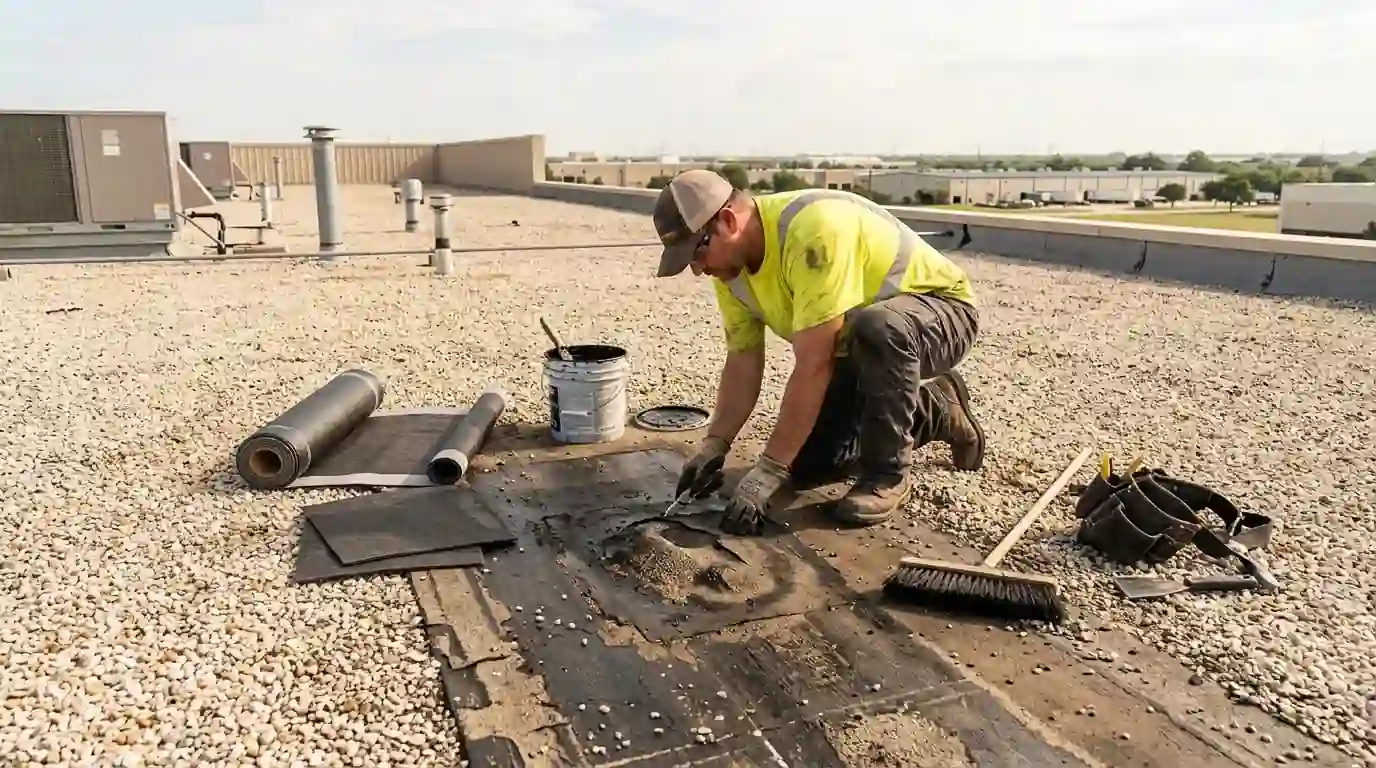
Blisters form where moisture trapped between plies expands in the heat; splits form where the membrane cracks over deck joints or where the building moves. We scrape back the gravel, cut out the blister or split to sound plies, dry the area, and re-ply it with new felts set in asphalt or adhesive, lapped well past the damage. The flood coat and gravel go back on top, so the repair is protected the same way as the rest of the roof.
Gravel stop and edge repair
The metal gravel stop along the roof edge keeps gravel on the roof and seals the membrane edge. When it rusts, lifts in wind or separates at the joints, water gets under the plies at the perimeter. We remove the failed metal, repair the plies beneath, install new gravel stop with sealed joints and a stripped-in membrane, and reset the gravel. Parapet walls get new coping or counterflashing at the same time. The perimeter is photographed before and after, because edge failures are what an insurer asks about after a windstorm.
Flood coat and gravel renewal
Over the years, rain and foot traffic wash gravel into drains and off the edges, leaving bare, sun-cracked patches. On a roof that is otherwise sound, we sweep off loose gravel, repair any damaged spots, apply a new flood coat of asphalt or a compatible coating, and embed fresh gravel. It restores the protective layer and often adds years to a roof that looked worse than it was. Drains are cleared of washed-in gravel at the same time, and strainers are replaced so the new gravel stays where it belongs.
Recovering an old built-up roof
When core cuts show wet insulation or the plies are failing across the field, repairs stop being economical. Where code allows and the deck is sound, we can recover the built-up roof: remove the gravel, add a cover board, and install a new TPO, PVC or modified bitumen system over it, which saves the cost of a full tear-off. Where the old roof is saturated, it comes off to the deck. The core readings are shared with you, so the choice is made on evidence rather than a sales pitch.
Roofing in Dallas
What we see on Dallas roofs
Dallas hail does not skip older commercial roofs: storm cells have dropped baseball-size hail heavy enough to damage skylights at NorthPark Center. On a built-up roof, the gravel layer absorbs a lot of that impact, which is one of the system's strengths, but hail still bruises bare patches and cracks the flood coat where the gravel has thinned. After a storm we check the bare areas first, because those are the ones that open up.
What happens after you call
How a built-up roof repair runs
Survey
Walk, core cuts and moisture readings.
Scope
Repair, renewal, recover or tear-off, with evidence.
Clear the area
Gravel scraped back from the repair.
Cut and dry
Damaged plies cut to sound material.
Re-ply
New felts set in asphalt or adhesive.
Resurface
Flood coat and gravel restored.
Photo report
Repairs located on a roof plan.
Timeline
How long BUR repairs take
Blister and split repairs are usually done in a day. Edge metal replacement runs one to two days depending on length. Flood coat and gravel renewal is scheduled by area, often a few days on a mid-size building, and a recover is planned like a replacement, in daily sections that are dried in before the crew leaves.
Questions we get
Built-up roof questions
Layers of roofing felt set in asphalt, usually topped with gravel.
Yes, by re-plying damaged areas and restoring the gravel surface.
Gravel washes into drains and off edges over time.
Not always, but it is trapped moisture that eventually splits.
After the loose gravel is removed and repairs are made, yes.
Core cuts decide: dry insulation allows a recover.
Yes, phased around tenants.
Often, if the plies and insulation are sound.
Gravel roof leaking? Have the plies looked at
A survey with core cuts tells you whether it is a repair, a renewal or a recover.