Repairs and roof components
Roof flashing repair in Dallas
Shingles rarely leak in the middle of a slope. They leak where the roof stops: against a chimney, up a wall, in a valley. That is flashing, and it is usually the first thing on a roof to go.
- We answer 24/7
- Dallas service office
- Metal bent and fitted on site
- 24/7Calls answered
- DallasService office
- EnnisHead office
- 1 to 2Days, most re-roofs
Quick answer
Roof flashing repair in Dallas means rebuilding the metal that seals the roof where it meets something else: step flashing woven with each shingle course up a wall, counterflashing let into a chimney's mortar joints and lapped over the step flashing, valley metal where two slopes meet, and a cricket behind wide chimneys. We replace failed flashing with new metal rather than covering it with sealant.
Warning signs
Signs your flashing has failed
Stain on the ceiling by the chimney
Counterflashing or cricket failing.
Water on an interior wall
Step flashing at a side wall.
Rust streaks in a valley
Valley metal rusting through.
Roofing cement smeared on flashing
Someone patched it before.
Siding tight to the shingles
No gap for step flashing.
Missing kick-out at a wall
Water running behind siding.
Loose metal on the chimney
Counterflashing pulled out of the joint.
The job
How flashing fails, and why caulk is not the fix
Flashing is layered, not glued. Step flashing laps with each shingle; counterflashing laps over the step flashing from the wall or chimney; water always runs over a lap, never into one. When a roofer skips a layer or a later repair smears roofing cement over the joint, the laps stop working and water finds the wall.
Most of the flashing leaks we find were caulked at least once already. The fix is to open the shingles, remove the failed metal and install it again in the right order.
Updated September 2026
Budget
What decides the cost of a flashing repair
Flashing work is priced by the detail; there is no published Dallas range that fits it. These factors set it.
- Which detail
A pipe boot is minor; a chimney rebuild is not.
- Metal
Galvanized, painted steel, aluminum or copper.
- Chimney size
Wider chimneys need a cricket.
- Siding type
Stucco and brick take longer to open than lap siding.
- Decking
Rot under a long-leaking flashing replaced per sheet.
- Roof material
Tile and slate take longer to lift and relay.
- Access
Steep, two-story or tall chimneys.
Chimney flashing and counterflashing
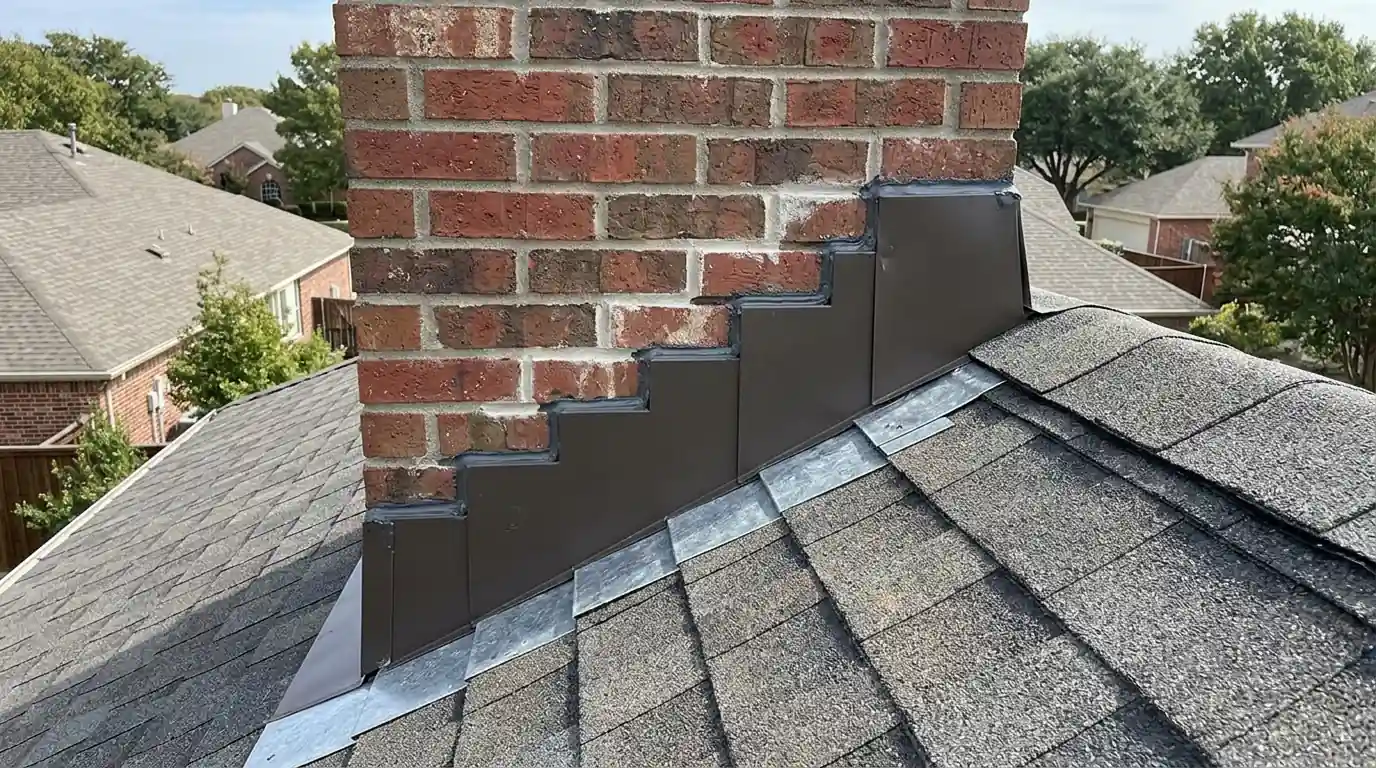
A chimney needs two layers: base and step flashing on the roof, and counterflashing set into the brick above it. We cut a reglet into the mortar joints with a grinder, insert new counterflashing, seal it into the joint, and lap it over new step flashing woven with the shingles. The front apron and back pan or cricket complete the job. Surface-mounted counterflashing that was only caulked to the face of the brick is the most common chimney leak we see.
Step flashing at walls
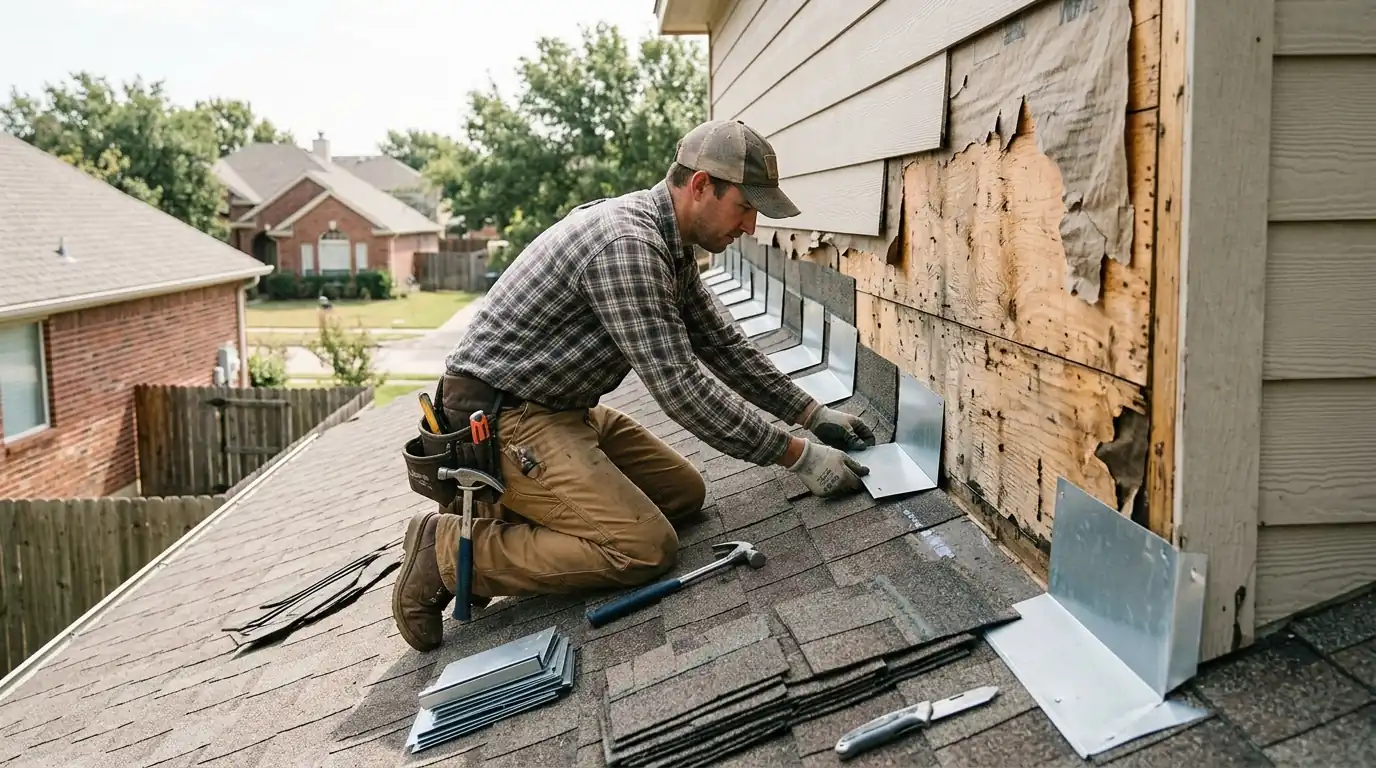
Where a roof slope runs up a side wall, each shingle course gets its own L-shaped piece of step flashing, with the siding or stucco lapping over its upright leg. On many houses the step flashing was replaced with one long piece, or the siding was pulled tight to the roof with no gap, and water wicks behind it. We remove the siding course along the wall, install new step flashing piece by piece, add kick-out flashing at the bottom so water goes into the gutter, and reset the siding.
Valley metal replacement
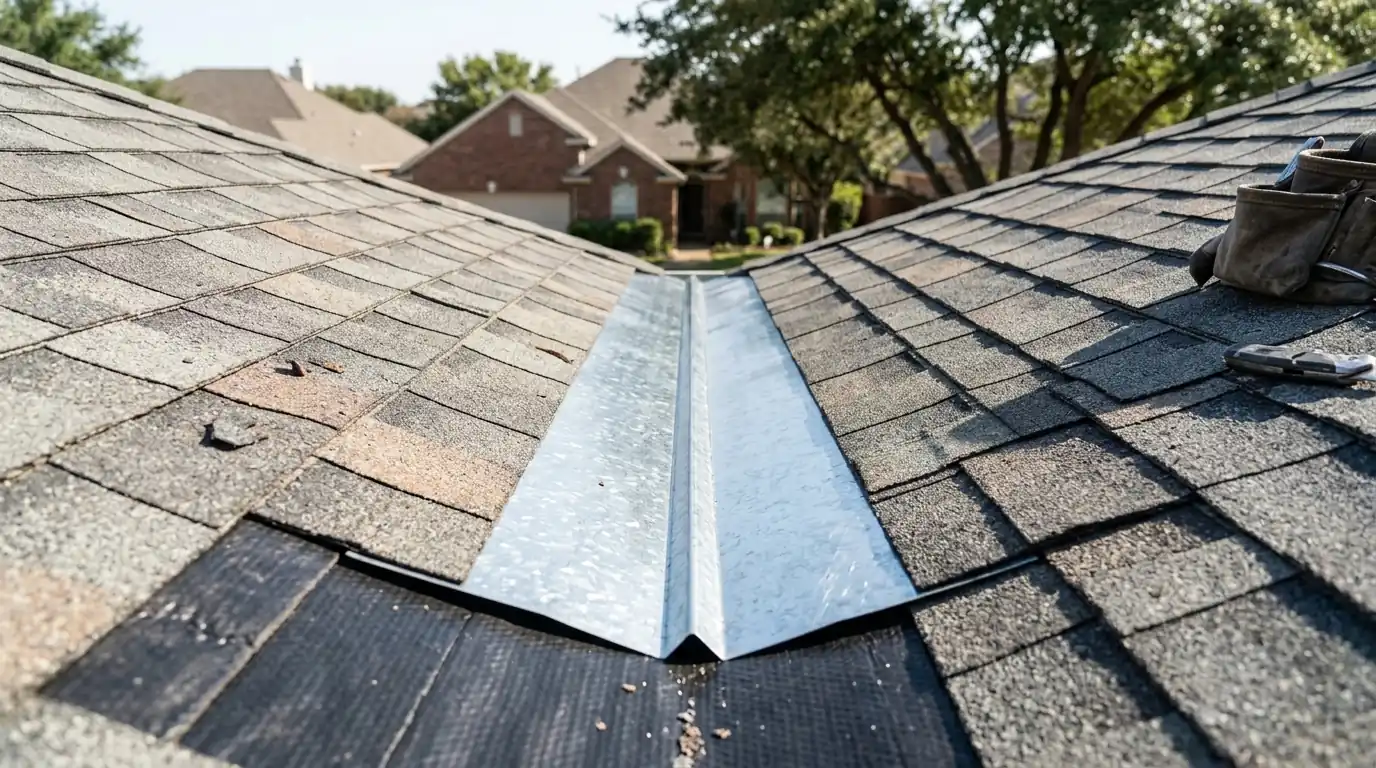
Valleys carry every drop from two slopes, so an open metal valley with rusted or pinholed metal leaks quickly. We strip the shingles back on both sides, install ice and water shield down the valley, and lay new pre-bent galvanized or painted steel valley metal with a center crimp to stop water crossing sides. The shingles are then cut back to a straight line along each side, with the corners clipped so water cannot run under them. Nail placement stays well clear of the valley center.
Chimney crickets
A chimney wider than about thirty inches on the uphill side acts as a dam; water and debris pile against its back and leak through the flashing. A cricket is a small peaked roof built behind the chimney that splits the water around both sides. We frame it, sheath it, cover it with ice and water shield and metal or shingles, and flash it into the chimney with the rest of the counterflashing. Many older Dallas chimneys never had one.
Roofing in Dallas
What we see on Dallas roofs
The Swiss Avenue Historic District in East Dallas is mostly homes from the 1900s to the 1920s in Prairie, Colonial Revival and Tudor styles, and a lot of them carry large masonry chimneys and steep intersecting roofs, which is where flashing work concentrates. On a designated landmark street, flashing work on a visible chimney is also something the city reviews for appearance, so we match the original metal and profile, often copper, rather than swapping in whatever is on the truck.
What happens after you call
How a flashing repair runs
Trace the leak
From the attic and the roof, at the detail.
Scope
Which layers failed and what they are rebuilt in.
Open the roof
Shingles lifted and siding opened where needed.
Remove failed metal
Old flashing and cement removed.
Underlayment
Ice and water shield at the detail.
New flashing in order
Base, step, counterflashing and cricket.
Close and test
Shingles and siding restored; hose tested.
Do it yourself or call
Patching flashing yourself or calling us
Flashing looks simple. The order of the layers is the whole job.
| Task | Doing it yourself | Having us do it |
|---|---|---|
| Caulking the chimney joint | Buys a season; hides the failure. | Counterflashing set into the mortar joint. |
| Replacing a pipe boot | Reasonable on a low roof. | Done on any visit. |
| Replacing step flashing | Requires lifting shingles and siding. | Piece by piece, with kick-out. |
| Replacing valley metal | Both slopes opened and relaid. | Ice and water plus new metal. |
| Building a cricket | Framing, sheathing and flashing. | Framed and flashed with the chimney. |
Questions we get
Flashing questions from Dallas homeowners
Stains near a chimney, wall or skylight, or down a valley, point to it.
Only as a stopgap; failed laps need new metal.
The metal set into the chimney or wall that laps over the step flashing.
If the chimney is wide on the uphill side, usually yes.
A small diverter at the bottom of a wall that turns water into the gutter.
Yes, especially on historic homes.
Yes; reusing old flashing is a common cause of new-roof leaks.
We patch it; texture and color are matched as closely as possible.
Stain near the chimney? It is almost always the flashing
We open it, find the failed layer, and rebuild it in metal, in the right order.