Commercial roofing
Commercial metal roofing in Dallas
Metal covers a large share of the warehouses, shops and newer retail buildings around Dallas. Installed and maintained right, it outlasts most other roofs; left alone, it leaks at the same places every time: fasteners, laps, trim and curbs.
- We answer 24/7
- Dallas service office
- Panels, retrofits and repairs
- 24/7Calls answered
- DallasService office
- EnnisHead office
- PhasedAround your tenants
Quick answer
Penfold Construction installs and replaces commercial metal roofs across Dallas: exposed-fastener R-panel and PBR roofs on warehouses and shops, structural standing seam on larger and lower-slope buildings, and retrofit metal systems framed over failing flat roofs. Every job starts with a walk of the roof and the structure, because the panel, the slope and the building's purlins decide which system fits.
The job
Choosing the right metal for the building
Commercial metal roofs differ mostly in how the panels are attached. Exposed-fastener panels are screwed through the face into the structure; they are economical and fast, but every screw is a future leak point. Standing seam panels are held by concealed clips, so the roof has almost no holes in it and the panels can move as they heat and cool.
Slope matters as much as the panel. Exposed-fastener panels need more pitch to shed water through their laps, while structural standing seam can handle much lower slopes. We match the system to the building rather than selling one panel for everything.
Updated September 2026
Budget
What moves the price of a commercial metal roof
We do not use a published Dallas range for commercial metal; panel choice, slope and the structure set the scope.
- Panel system
Exposed-fastener panels cost less than standing seam.
- Gauge and finish
Heavier gauge and better coatings cost more and last longer.
- Roof area and shape
Priced per square foot, with hips and valleys adding labor.
- Insulation
Faced blanket, rigid board or none, by building use.
- Tear-off or retrofit
Removal, recover or sub-framing over the old roof.
- Penetrations and units
Factory curbs and flashings at every opening.
- Access
Lifts, staging and work around operations below.
Your options
R-panel or standing seam
The two common commercial metal systems, compared.
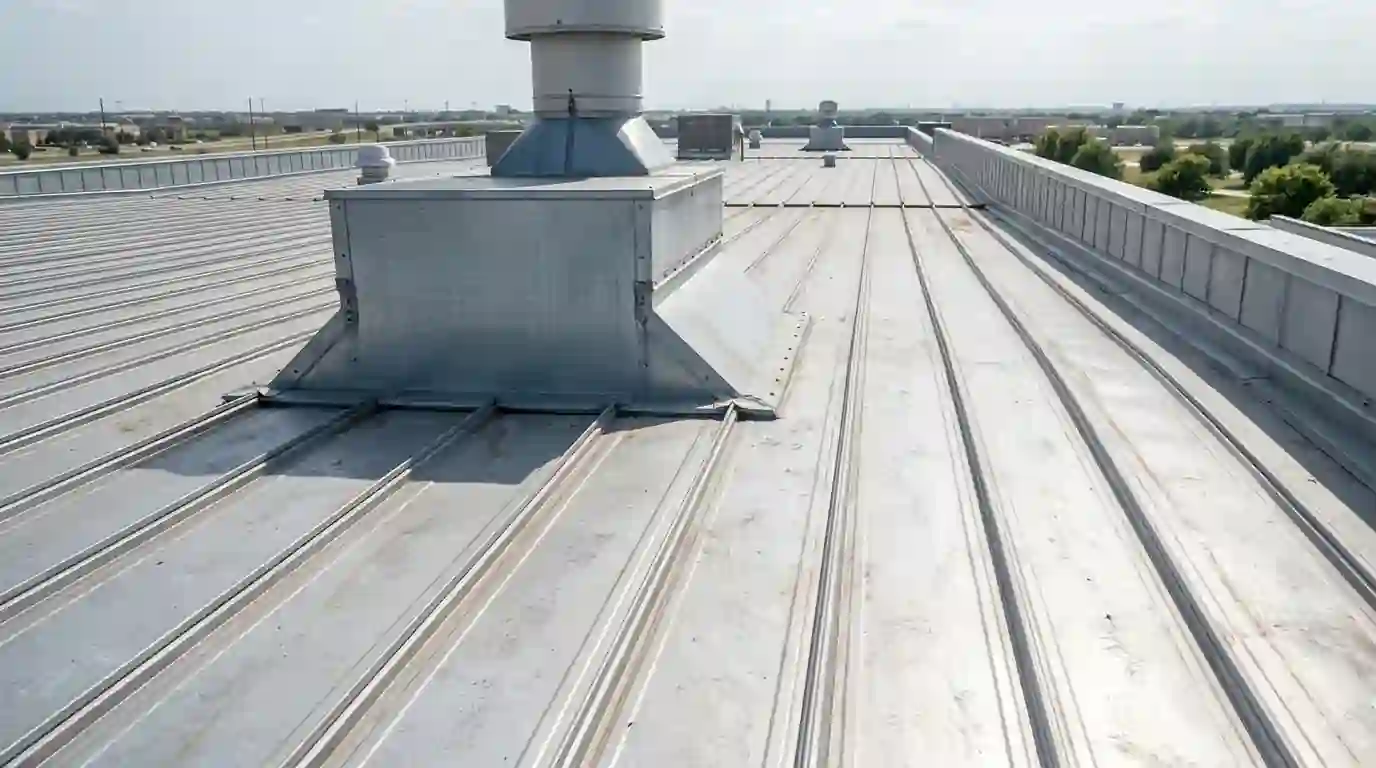
| Compare | R-panel / PBR | Structural standing seam |
|---|---|---|
| Attachment | Screws through the panel face | Concealed clips; panels float |
| Slope | Needs more pitch to shed water | Handles low slopes |
| Upkeep | Fasteners and laps need regular checks | Very few holes to maintain |
R-panel and PBR roofs
R-panel and its heavier cousin PBR are the familiar ribbed panels on warehouses, shops, barns and many strip-center rear roofs. They go on fast over open purlins and cost less than standing seam. The trade-off is maintenance: the screws through the panel face carry rubber washers that age in the sun, and the panels expand and contract with every hot day, slowly working fasteners loose. On a new R-panel roof we use quality fasteners, sealant at every lap and proper closures at the ridge and eaves. On an existing one, our metal roof repair page covers fastener replacement and seam sealing, the work that keeps these roofs dry for decades.
Structural standing seam
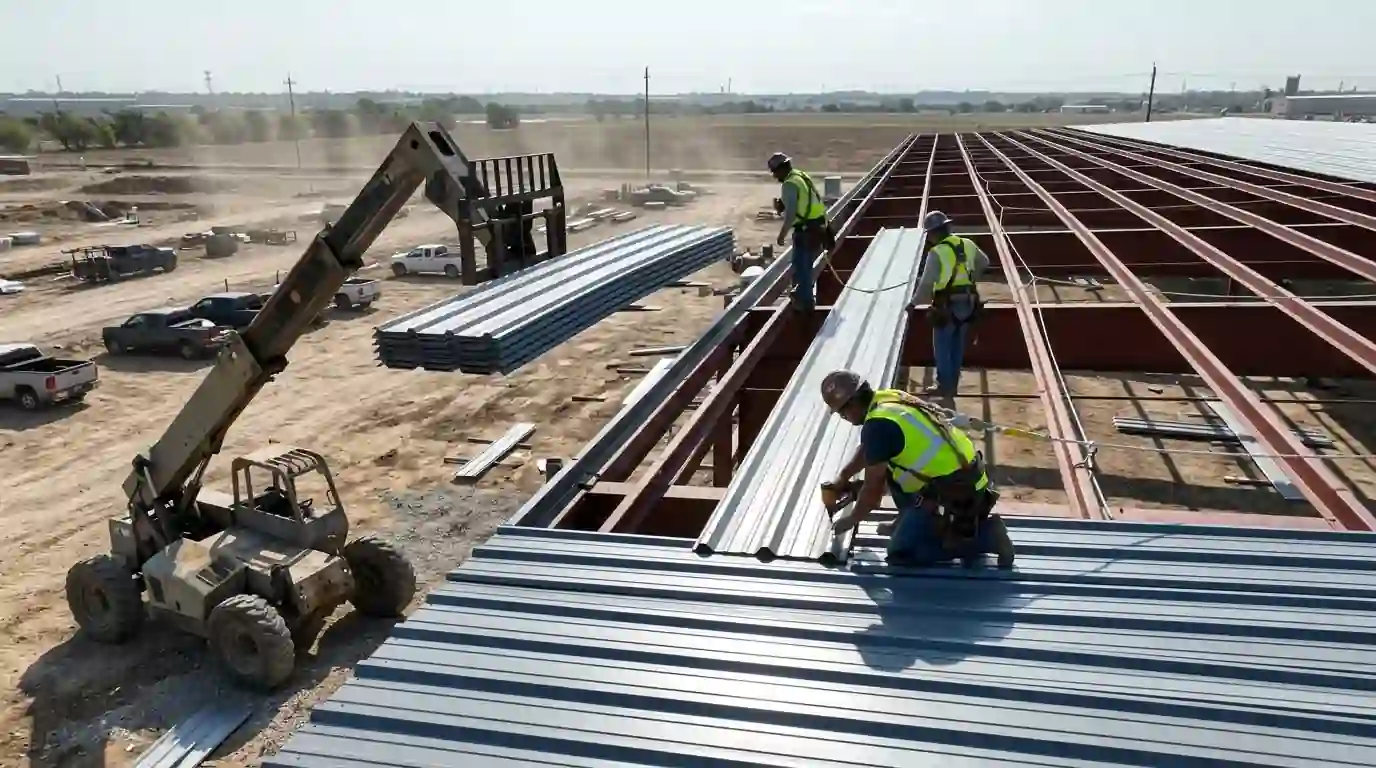
Structural standing seam panels are attached with concealed clips that let each panel slide as it expands, and the seams are mechanically locked above the water line. That makes them suitable for low slopes where an exposed-fastener panel would leak through its laps, and it means there are very few holes through the roof. Standing seam costs more up front, but on a large building with a long ownership horizon, the reduced maintenance usually pays for the difference. Penetrations are flashed with factory curbs rather than sealant.
Retrofit metal over a flat roof
Many older Dallas buildings have flat built-up or membrane roofs that pond water and leak no matter how often they are patched. A retrofit system frames light-gauge steel sub-purlins over the existing roof to create real slope, then a new metal roof goes on top. The old roof usually stays in place underneath, which avoids a messy tear-off over an occupied building, and the space between the roofs can be insulated. It is a bigger project than a coating or a recover, so we only recommend it where the existing roof cannot be made to drain any other way and an engineer confirms the structure can carry the new frame.
Hail and commercial metal
Hail rarely punctures commercial metal panels, but it dents them, and how that is handled depends on the policy. Many commercial insurance policies now exclude cosmetic damage on metal roofs, paying only when the hail affects how the roof sheds water. After a storm we document dents, cracked fasteners, damaged trim, skylights and rooftop units separately, with photos and measurements, so you and your adjuster can see which damage is functional. Heavier-gauge panels resist denting better on a new roof.
Roofing in Dallas
What we see on Dallas roofs
Southern Dallas County holds several established industrial parks and most of the county's remaining room to build, so metal warehouse and shop roofs are a large part of commercial roofing around Dallas. Many of those roofs are now old enough that their original fasteners and sealants are failing. Our head office in Ennis also sees the rural side: metal shops, barns and commercial buildings across Ellis County that take the full force of spring wind on open ground.
Warehouse roof leaking onto stock?
Call any hour. We stop the water first and come back to fix the cause.
(214) 429-4542What happens after you call
How a commercial metal roof job runs
Walk the roof
Panels, fasteners, trim, purlins and penetrations checked.
Recommendation
Repair, restore, re-sheet or retrofit, in writing.
Engineering
Structure confirmed for retrofits and heavier systems.
Materials
Panels ordered to length with matching trim.
Install
Panels, closures, trim and curbs in sequence.
Inspect
Fasteners, seams and flashings checked before we leave.
Hand-off
Warranty paperwork and a maintenance plan.
Timeline
How long commercial metal work takes
Fastener and seam restoration on an existing roof usually takes days. Re-sheeting a building or installing a new standing seam roof takes from about a week to several, depending on size, panel lead time and weather, and retrofit projects add framing and engineering time at the front. We phase work so the building stays dry and in use.
Questions we get
Commercial metal roofing questions
R-panel costs less; standing seam lasts longer with less maintenance.
Washers age and panels move with heat, working fasteners loose.
Yes, with a retrofit frame that adds slope over the old roof.
It dents them; many policies only pay for damage that affects function.
Yes, with faced blanket or rigid board, matched to the building.
Yes, over the existing purlins once they are checked.
Yes; our Ennis office covers Ellis County.
Decades, if fasteners and seams are maintained.
Metal roof leaking at the screws?
We walk the roof, check the fasteners and seams, and tell you whether it needs a repair, a restoration or new panels.