Commercial roofing
Commercial roof replacement in Dallas
A flat roof reaches the point where every repair uncovers two more: wet insulation, open seams, ponding that will not drain. Replacement is then cheaper than chasing leaks, and it can be done without shutting the building.
- We answer 24/7
- Dallas service office
- Phased around operations
- 24/7Calls answered
- DallasService office
- EnnisHead office
- PhasedAround your tenants
Quick answer
Commercial roof replacement in Dallas means removing or recovering the old roof, replacing wet insulation, adding tapered insulation where water ponds, and installing a new single-ply TPO, PVC or EPDM membrane or a modified bitumen system, with new edge metal, flashings and drains. Work is phased section by section, dried in each day, so tenants and operations keep running underneath.
The job
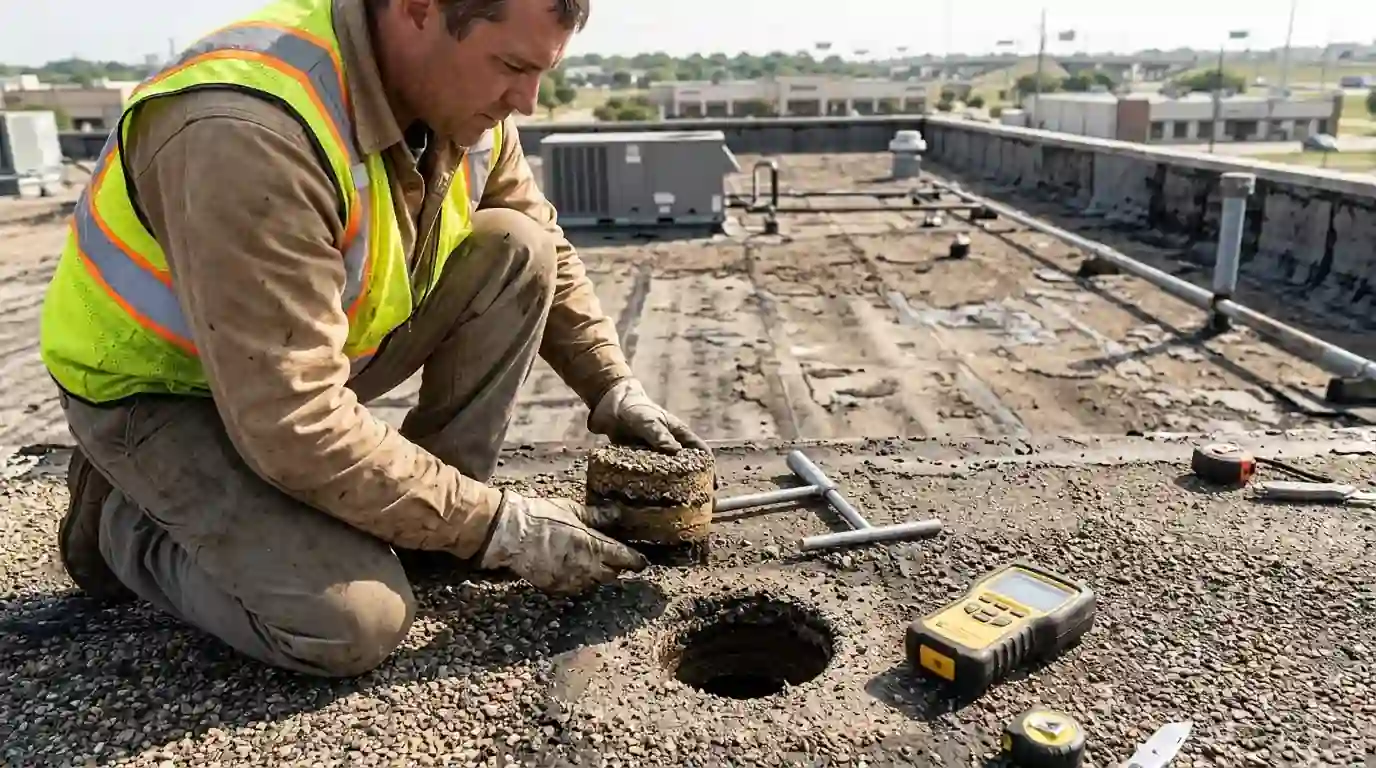
Replacement starts with a moisture survey
The deciding question on a commercial roof is how much of the insulation is wet. A roof with sound, dry insulation can often be recovered, with a new membrane over the old; a roof with widespread wet boards has to come off to the deck. We take core cuts and moisture readings across the field before quoting, and show you the map.
That survey also picks the system. A white TPO or PVC membrane cuts cooling load on a Dallas summer roof; modified bitumen handles foot traffic; EPDM suits certain retrofit details.
Updated September 2026
Budget
What a commercial replacement costs
There is no published Dallas range we would stand behind for commercial replacement; the moisture survey and system choice set the number.
- Roof area
Priced per square across the field.
- Tear-off or recover
Recover saves removal when insulation is dry.
- Wet insulation
Replaced boards from the moisture survey.
- Tapered insulation
Crickets and saddles to stop ponding.
- System choice
TPO, PVC, EPDM or modified bitumen.
- Edge metal and drains
New coping, gravel stop and drain bodies.
- Phasing
Occupied buildings are done in daily sections.
Your options
Which membrane fits your building
Three common systems on Dallas commercial roofs.
| Compare | TPO / PVC | EPDM | Modified bitumen |
|---|---|---|---|
| Color and heat | White, reflective | Black unless coated | Granule cap, light or dark |
| Seams | Heat welded | Taped and primed | Torched or adhered laps |
| Best for | Conditioned space, restaurants (PVC) | Unconditioned buildings, retrofits | Heavy rooftop traffic |
Scope
What a commercial replacement includes
Every bid carries the same items so it can be compared.
- Moisture survey with core cuts
- Wet insulation removed and replaced
- Tapered crickets at drains and walls
- New cover board where specified
- Membrane installed per manufacturer
- Curbs and penetrations reflashed
- New edge metal and coping
- Drains reset or replaced
- Walkway pads to rooftop equipment
TPO and PVC single-ply
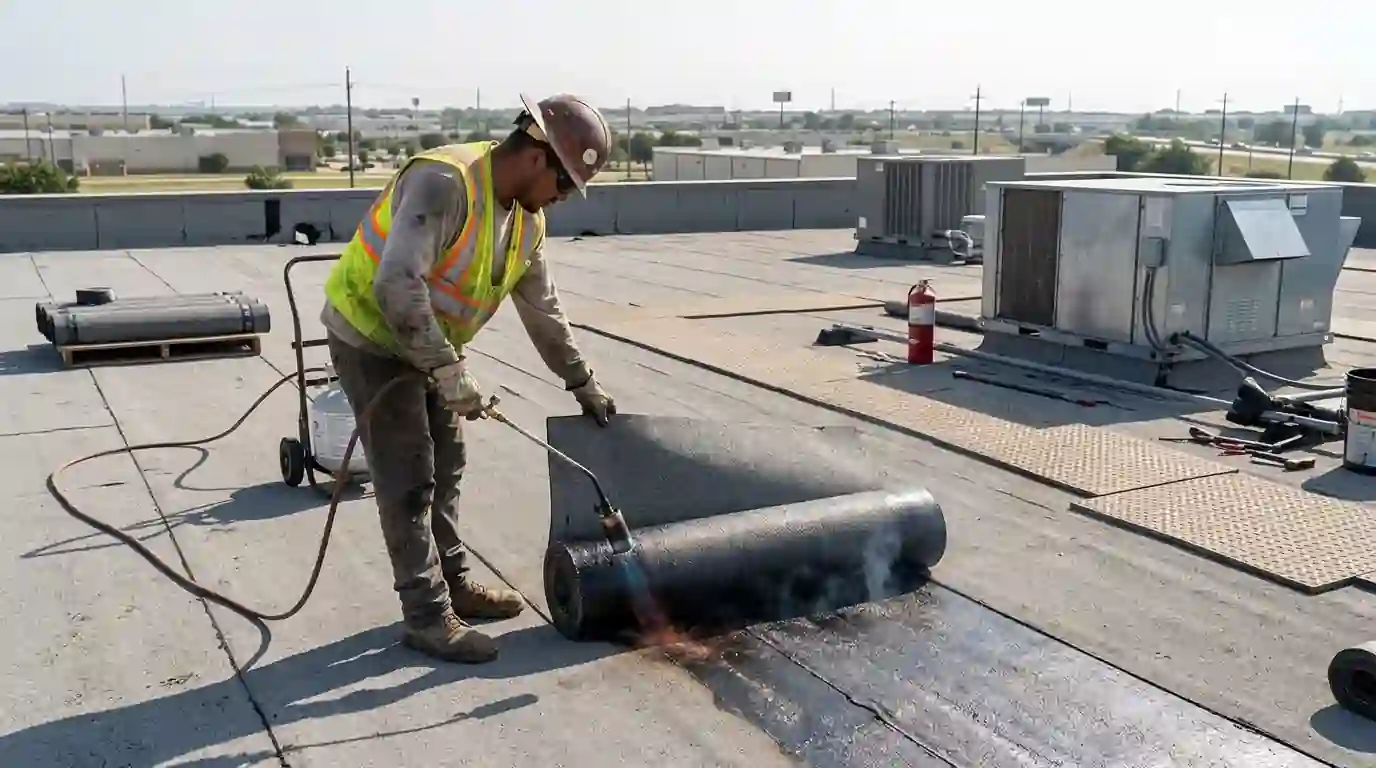
TPO and PVC from Carlisle SynTec, Firestone or Versico are white thermoplastic membranes, heat welded at every seam into one continuous sheet. They reflect most of the summer sun, which matters on a large Dallas warehouse or retail roof, and the welds are stronger than the membrane itself. PVC resists grease and chemicals, so it goes on restaurants and any roof with kitchen exhaust. We install mechanically fastened or fully adhered, over new polyiso insulation with tapered crickets at every drain. Membrane thickness is specified in the bid, never left to guesswork.
EPDM rubber
EPDM is a black synthetic rubber membrane with decades of track record, seamed with tape and primer rather than heat. It tolerates movement well, which suits older buildings and odd retrofit details. In Dallas its black surface absorbs heat, so on air-conditioned space we usually recommend white TPO or a coated EPDM instead; on unconditioned warehouses and canopies it remains a sound, economical choice, and we will say plainly which fits your building. Flashings at curbs and walls use the same membrane family so the seams bond properly.
Modified bitumen
Modified bitumen is asphalt reinforced with polyester or fiberglass and modified with rubber-like polymers, installed in two or more plies with a granule-surfaced cap sheet. It handles foot traffic and rooftop equipment service better than single-ply, so it suits roofs with heavy mechanical traffic. We install torch-down, hot-mopped or cold-applied depending on the building and its occupancy, and add walkway pads to every service route across the roof. On an occupied building we choose the application method around fumes and fire watch requirements, so the work fits how the building is used.
Tear-off vs recover
A recover installs new insulation and membrane over the old roof and saves the tear-off cost, but code generally allows it only when there is one existing roof and the insulation beneath is dry. A tear-off removes everything to the deck, exposes any rusted metal deck, and resets the drainage. The moisture survey decides it, and we show you the readings rather than asking you to take the recommendation on faith. Recovered roofs get a cover board and new edge metal, so they are not simply a membrane laid over a problem.
Roofing in Dallas
What we see on Dallas roofs
Baseball-size hail from isolated cells has cracked skylights at NorthPark Center, so commercial roofs across the city carry real hail exposure, and DFW averages one significant hail event a year that damages roofs across the metroplex. After a large one, contractor calendars fill for months. For a commercial owner that argues for planning a replacement in the off-season, with the membrane and cover board chosen for impact, rather than scheduling one under pressure after the next storm.
What happens after you call
How a commercial replacement runs
Roof survey
Core cuts, moisture readings and a marked roof plan.
System and scope
Membrane, insulation, tapered design and edge details.
Phasing plan
Daily sections scheduled around tenants and operations.
Permit
Commercial roofing permit pulled with the city.
Section by section
Old roof removed or prepared, insulation and membrane installed.
Dried in daily
Every opened section closed before the crew leaves.
Closeout
Flashings, drains and edge metal finished; photo record and inspection.
Brands we install and service
Questions we get
Commercial replacement questions
Yes. We work in daily sections and dry in each one.
Usually white TPO or PVC for cooling; PVC where grease or chemicals are present.
Only with one roof and dry insulation. Afterward, scheduled roof maintenance protects the warranty.
Core cuts and moisture readings across the field.
Yes, with tapered insulation crickets and drain work.
We document the damage and meet the adjuster.
From days to a few weeks depending on area and phasing.
Yes, including restoration coatings and panel repair.
Chasing leaks on a tired flat roof? Get it surveyed
A moisture survey shows whether you need a recover, a tear-off or just a good repair, with the readings to back it.