Roofing guide
How to read your insurance roof estimate in Texas
The adjuster's estimate arrives as several pages of codes, quantities and abbreviations, and the number at the bottom is not the check you will get. Here is how to read it, line by line.
- We answer 24/7
- Dallas service office
Quick answer
A Texas insurance roof estimate starts with replacement cost value (RCV), the full cost of the work. Depreciation is subtracted to reach actual cash value (ACV), and your deductible comes off that, which gives the first check. On a replacement-cost policy, recoverable depreciation is paid after the work is done. Check the line items for squares, waste, drip edge, starter, underlayment and flashing, and add anything missing through a documented supplement.
By Cyril Cross, Roofing Guides Editor · Updated September 2026
The summary page, from the top
Most carriers write roof estimates in the same estimating software, so the summary page usually follows the same pattern. Read it from the top:
- Replacement cost value (RCV): what the covered work costs at today's prices.
- Depreciation: an amount subtracted for the roof's age and wear, split into recoverable and non-recoverable.
- Actual cash value (ACV): RCV minus depreciation.
- Deductible: your share, subtracted from the ACV.
- Net claim: what the first check is written for.
On a replacement-cost policy, recoverable depreciation is held back until the work is done and the insurer receives proof, usually the final invoice. On an actual-cash-value policy, that depreciation is gone for good, which is why the same hail can produce very different checks on two houses on one street. The repair or replace guide explains how roof age changes this in Texas.
Line items, units and the waste factor
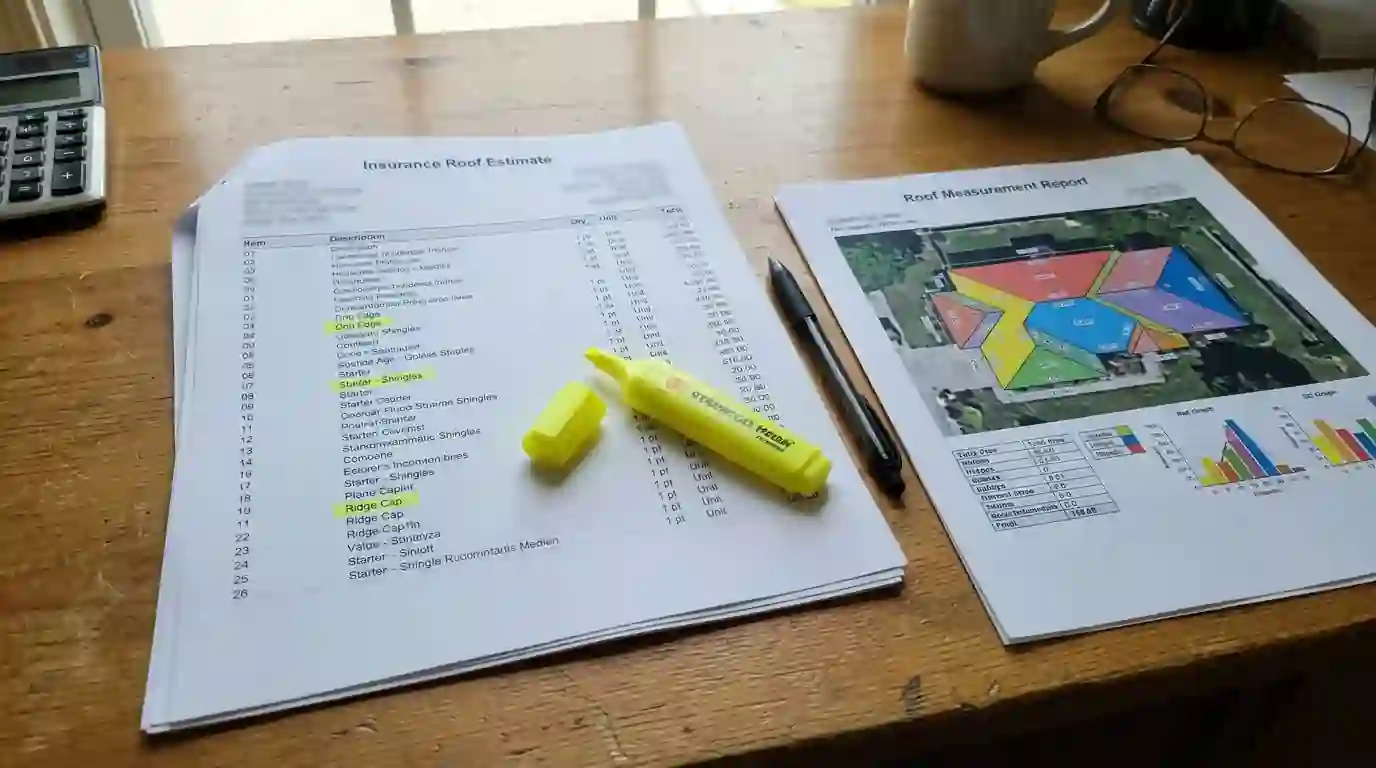
Below the summary, each slope or elevation gets its own list. Quantities are in squares (SQ, 100 square feet of roof), linear feet (LF) for edges and ridges, and each (EA) for pipe boots and vents. Check that the square count matches a measurement of your roof, and that the shingle line includes a waste factor; cutting hips and valleys always wastes material, and the more complex the roof, the higher it should be.
Then look for the parts of a roof that are easy to forget: drip edge on the eaves and rakes, starter strip, hip and ridge cap, underlayment, ice and water barrier where required, step and counter flashing, pipe jacks, and every vent. Steep roofs and high roofs usually carry separate labor charges for the extra safety work, and they belong on the estimate if your roof qualifies.
What is most often missing
Items are missed most often for one simple reason: the adjuster did not see them or the estimate was written from a template. Common gaps on Dallas roofs include:
- Code-required items, such as drip edge or underlayment details the local code calls for.
- Detach and reset of satellite dishes, solar panels or gutter guards.
- Damaged gutters, downspouts and window screens on the same claim.
- Decking replacement, which cannot be counted until tear-off.
- Permit and inspection fees.
Missing items are added through a supplement: a written request with photos, measurements and the code section or manufacturer instruction behind it. A phone call is not a supplement. We document every one on our storm replacement jobs, and you approve what is sent.
Talk to a Dallas roofer now
Describe the leak or the damage, and we will tell you whether it needs a tarp tonight or a scheduled visit this week.
(214) 429-4542Overhead and profit
Overhead and profit, often shown as O&P, pays a general contractor to coordinate a job with several trades, such as a roof, gutters and interior ceiling repairs on the same claim. It is commonly calculated as 10 percent overhead and 10 percent profit. Whether it applies depends on the policy and how complex the job is; on a roof-only claim, it is often left off. If your claim involves several trades, ask the adjuster whether O&P was considered.
The deadlines your insurer has to meet
Texas sets claim deadlines in Chapter 542 of the Insurance Code. Within 15 days of receiving notice of your claim, the insurer must acknowledge it, start investigating and request what it needs from you. Once it has everything, it has 15 business days to accept or reject the claim in writing, and it can extend that once by up to 45 days if it explains why. After it accepts all or part of the claim, payment is due within 5 business days. After a declared weather catastrophe, the deadlines stretch by 15 days.
Keep a dated log of every call, email and document. It is the simplest way to know whether those clocks are running.
When you disagree
Start with a reinspection request, ideally with your roofer on the roof, and a written supplement for anything specific. Many Texas homeowner policies also include an appraisal clause for disputes about the amount of loss. A roofer cannot negotiate your claim for you in Texas, and no contractor can legally waive or cover your deductible. What a roofer can do is make sure the roofing facts in front of the adjuster are complete. If the storm was recent, the first steps after hail are worth reading too.
Questions we get
Insurance estimate questions
Replacement cost value: the full cost of the covered work at current prices.
Depreciation and your deductible are subtracted first.
On a replacement-cost policy, send proof the work is done, usually the final invoice.
Through a supplement: a written request with photos and documentation for items the estimate missed.
15 business days after it receives everything it requested, with one possible extension.
No; in Texas a roofer can document the roof, not negotiate the settlement.
No; that is illegal in Texas.
Estimate in hand and not sure it is complete?
We measure the roof, compare the estimate line by line and show you what is missing, with photos.