Jacksonville, FL
Finding and fixing AC refrigerant leaks in Jacksonville
Electronic leak detection, nitrogen pressure testing and repairs on coils, line sets and fittings, so the refrigerant stays in the system instead of being refilled every year.
Quick answer
Can an AC refrigerant leak be repaired in Jacksonville, FL?
Yes, most AC refrigerant leaks in Jacksonville can be found with electronic detection and nitrogen pressure testing and repaired at the fitting, line set or coil. Salt-corroded coastal coils and badly pitted evaporator coils are the exception and usually need a coil replacement.
Warning signs
Signs of a refrigerant leak
Cooling gets weaker each summer
Charge slowly dropping over months.
Ice on the copper lines
Low charge makes the coil run too cold.
Hissing near the indoor or outdoor unit
A larger leak at a fitting or coil.
Oily residue on fittings
Refrigerant oil escapes with the gas.
Long run times, higher bills
The system runs longer to do the same work.
Someone keeps adding refrigerant
The clearest sign of an unrepaired leak.
Overview
Refrigerant doesn't get used up
An AC is a sealed loop. The refrigerant circulates, it isn't consumed, so if the charge is low there's a leak. Adding refrigerant without finding it treats the symptom and guarantees a repeat call.
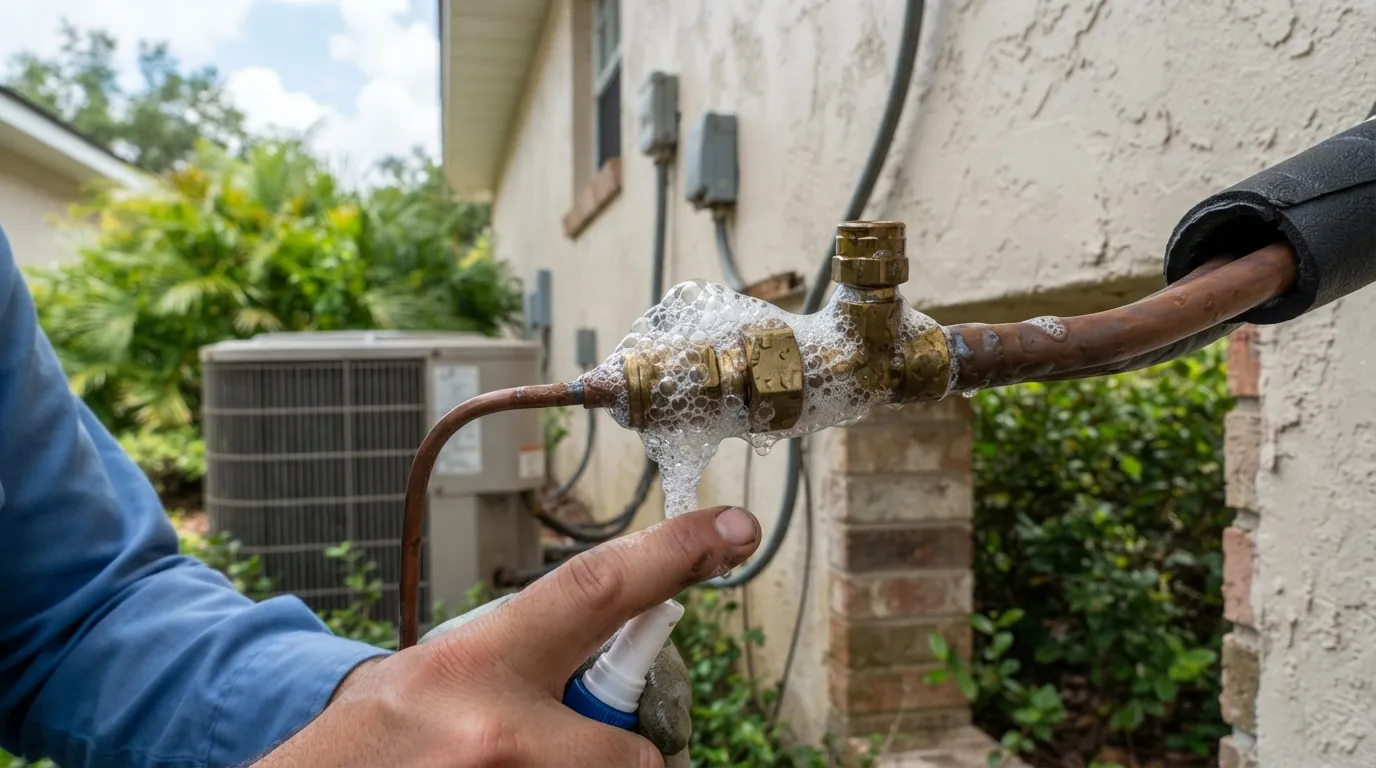
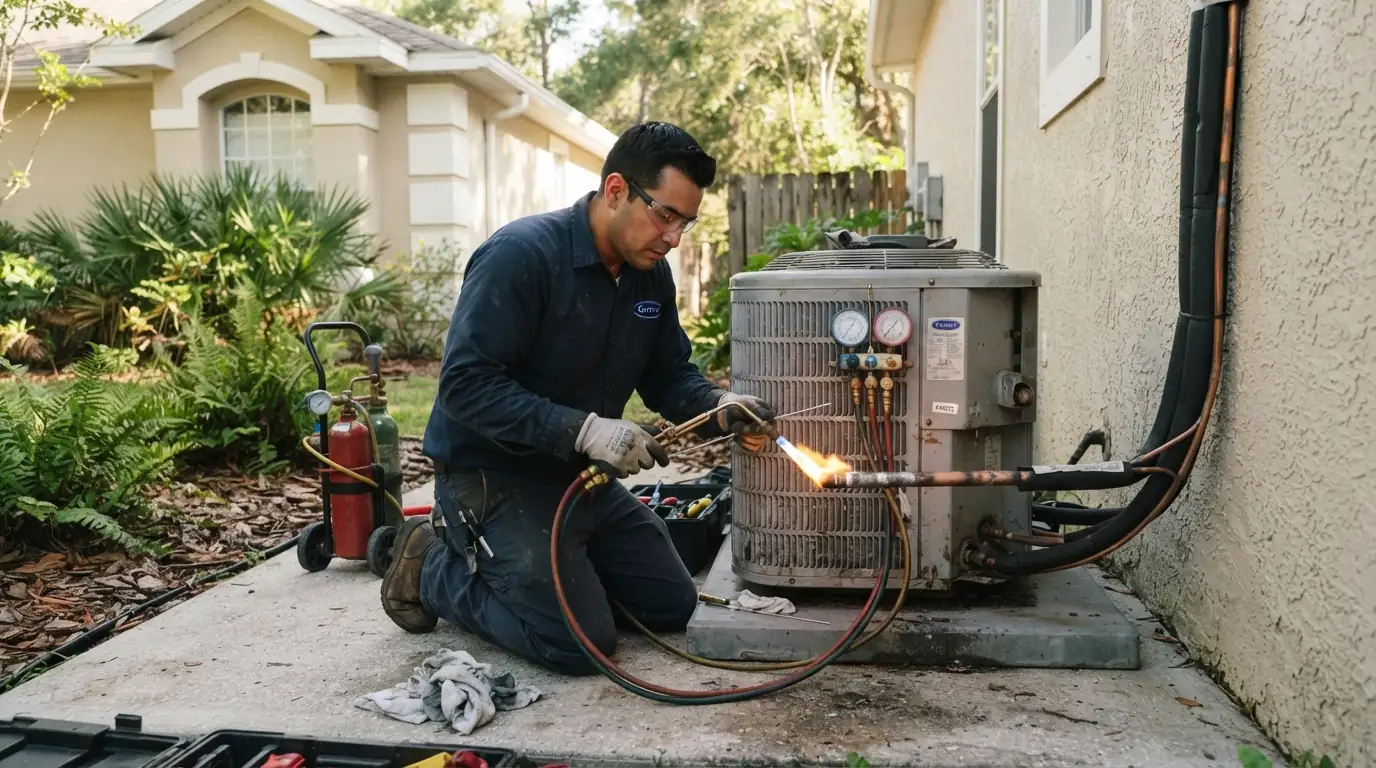
We find leaks with an electronic detector, bubble solution at fittings, and when needed by pressurizing the system with dry nitrogen and watching for pressure drop. Once found, the leak is repaired, the system pressure tested and evacuated, then charged to specification.
What we fix
Evaporator coil leaks
The indoor coil is the most common leak spot in Florida systems. Formicary corrosion, tiny pinholes eaten into the copper, forms over time in humid conditions. A single accessible pinhole can sometimes be repaired, but coils with scattered corrosion usually keep leaking. In that case we'll price a coil replacement matched to the outdoor unit, and on older systems a full replacement for comparison. We'll show you where the leak is and why we recommend what we do, including photos when the coil is hard to see.
Line set leaks
The copper lines between the units can leak at flare fittings, brazed joints, or where they rub against framing or a wall sleeve. Service valves on the outdoor unit are another common spot. These are usually very repairable: the joint is rebrazed, the fitting replaced or the damaged section cut out and spliced. After the repair we pressure test with nitrogen before evacuating and recharging, so we know it's actually tight. A repair that isn't tested is just a guess.
Salt corroded condenser coils
Near the coast, salt pits the outdoor coil's aluminum fins and tubes until pinhole leaks appear across the face of the coil. These rarely patch successfully because the metal around the leak is already weakened. The honest options are replacing the outdoor coil where the part is available, or replacing the condenser, ideally with a coastal grade unit. We'll show you the corrosion before recommending either, so you can see why patching isn't worth it. Pricing both options side by side keeps the choice yours.
How the job runs
How a leak repair runs
- 1
Confirm low charge
Pressures and superheat or subcooling read.
- 2
Locate the leak
Electronic detector, bubble test, nitrogen if needed.
- 3
Written price
Repair or coil replacement, and system replacement on older units.
- 4
Repair and test
Leak repaired and nitrogen pressure tested.
- 5
Evacuate and charge
Deep vacuum, then charge to specification.
Timing
How long a leak repair takes
Finding and fixing an accessible fitting or line set leak is usually one visit. Leaks that only appear under nitrogen pressure take longer to locate. A coil replacement depends on getting the matched coil, so we'll give you the date before ordering.
Where leaks come from in Jacksonville systems
Two patterns account for many leaks we see. Near Ponte Vedra and the other beach communities, salt air pits outdoor coils until they leak across the face. Farther inland, in Mandarin's 1970s and 1980s subdivisions, systems are on their second or third replacement, and older line sets and fittings reused from earlier installs are a frequent source of slow leaks. Knowing the house's location and history helps us decide where to look first.
DIY or call
Recharge kits and what to leave to us
| Task | Safe to try yourself | Leave to a technician |
|---|---|---|
| Checking for ice on the lines | Yes, then turn the system off | Call once it thaws |
| Looking for oily spots on fittings | Yes | We confirm with a detector |
| Using a store recharge kit | No, it often overcharges and adds sealant | Yes, leak found and repaired first |
| Adding refrigerant | No, it requires EPA certification | Yes |
| Brazing or replacing fittings | No | Yes |
Brands we service and install
Trane, Carrier, Lennox, Rheem, Goodman, Daikin, Mitsubishi Electric, American Standard, Bryant, Ruud, Amana, Honeywell, York, Heil
Cost factors
What affects the cost of a leak repair
- Leak locationAn accessible fitting costs far less than a coil.
- Detection timeHard-to-find leaks need nitrogen testing.
- RefrigerantRecharge cost depends on refrigerant type and amount.
- Coil replacementCorroded coils usually mean a replacement part.
- System ageOlder systems may justify replacement over a coil repair.
Every leak repair is priced in writing once the leak is located.
FAQ
Refrigerant leak questions
Is it normal to add refrigerant every year?
No. Low refrigerant always means a leak.
Can you use a sealant instead?
We don't recommend it. Sealants can clog valves and rarely hold.
Can a leaking coil be patched?
Sometimes, if the leak is single and accessible. Corroded coils usually need replacement.
How do you find small leaks?
Electronic detection, bubble solution and nitrogen pressure testing.
What if my system uses R-22?
R-22 is no longer produced and is expensive. On leaking R-22 systems we'll price replacement alongside repair.
Why are beach-area coils worse?
Salt air pits aluminum coils faster than inland air.
Do you repair leaks on every AC brand?
Yes, including Carrier, Trane, Lennox, Goodman and Rheem.
Related services
Other work on the same system
Emergency AC Repair
After-hours and weekend AC calls, answered live and dispatched to the next open technician.
Learn moreAC Repair
Warm air, frozen coils, dead capacitors and fans that stop: diagnosed with readings, priced before work.
Learn moreAC Compressor Repair
Compressors that hum, trip or won't start, tested before anyone says replace.
Learn moreCondensate Drain Line Cleaning
Clogged drain lines cleared and treated, float switch tested.
Learn moreFix the leak, not just the charge
Call any hour. We'll find the leak, repair it and pressure test before recharging.